
How Concorde Flew Faster Than the Speed of Sound
One Moment You Were in London. Three Hours Later, You Were in New York.
Imagine looking out of your airplane window.
The sky above is almost black.
The Earth below appears to curve.
Your aircraft is traveling faster than a rifle bullet.
By the time most passengers finish watching one movie on a modern airliner, you have already crossed the Atlantic.
Get the SkypropreAir Free Travel Pack
Plan smarter, choose a better seat and enjoy a more comfortable long-haul journey. Enter your details below to receive the Travel Pack.
It sounds like science fiction.
But for nearly three decades, it was reality.
The Concorde wasn’t simply another airplane—it was humanity’s boldest attempt to conquer time itself. Flying at more than twice the speed of sound, it transformed international travel into something that felt almost impossible.
Even today, more than two decades after its retirement, no commercial aircraft has matched its breathtaking speed.
So how did Concorde accomplish what no modern passenger jet has been able to repeat?
The answer lies in one of the greatest engineering achievements in aviation history.
Related Reading: Why the Airbus A380 Is Still the World’s Favorite Airplane | Future Airplanes Could End Turbulence as We Know It
What Does “Faster Than the Speed of Sound” Actually Mean?
Sound travels through air at approximately 767 mph (1,235 km/h) at sea level.
This speed is known as Mach 1.
Concorde routinely cruised at around Mach 2.04, roughly 1,354 mph (2,180 km/h) at an altitude of about 60,000 feet.
Modern commercial airliners typically cruise between Mach 0.78 and Mach 0.85.
That means Concorde crossed the Atlantic in nearly half the time.
The Challenge That Stops Most Airplanes
Flying faster than sound is extraordinarily difficult.
As an aircraft approaches Mach 1, compressed air forms powerful shock waves that dramatically increase drag and stress on the airframe.
For decades, many believed passenger aircraft would never safely pass this barrier.
Concorde proved otherwise.
Related Reading: The Most Dangerous Phase of Every Flight explains how aircraft safely manage their most demanding moments.
The Sleek Delta Wing That Made Supersonic Flight Possible
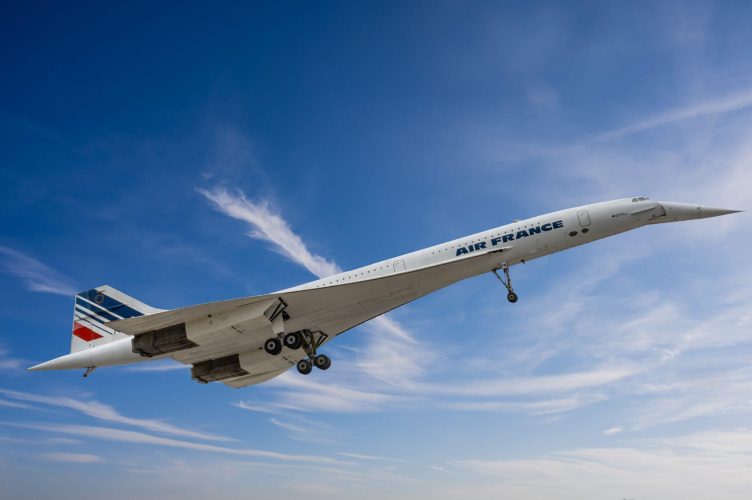
Concorde’s iconic delta wing wasn’t designed for appearance—it was engineered for Mach 2 performance.
Its triangular shape reduced drag, improved stability, and generated efficient lift at extremely high speeds.
Although it required higher takeoff and landing speeds than conventional airliners, it became one of aviation’s most recognizable engineering achievements.
Planning Your Next Flight?
Whether you’re flying across the Atlantic or exploring Europe, compare fares before you book.
- Compare flight prices with Aviasales and find the best available deals for your route.
Four Engines Built for Incredible Power
Concorde relied on four Rolls-Royce/Snecma Olympus 593 turbojet engines.
During takeoff and acceleration through the sound barrier, they used afterburners, injecting extra fuel into the exhaust stream to generate enormous thrust.
Once the aircraft reached Mach 2 cruise, the afterburners were switched off, allowing Concorde to maintain supersonic flight more efficiently.
Flying So High That the Sky Turned Dark
Most commercial aircraft cruise between 35,000 and 41,000 feet.
Concorde flew at around 60,000 feet, where the air is thinner and aerodynamic drag is significantly reduced.
Passengers often noticed the sky appearing much darker than on ordinary flights, while some could even see the gentle curvature of the Earth.
It was one of the closest experiences to spaceflight available on a commercial airliner.
Related Reading: What Sunrise Looks Like From a Cockpit at 39,000 Feet reveals another breathtaking view that few travelers ever experience.
Concorde Expanded While Flying
At Mach 2, friction heated Concorde’s aluminum skin to temperatures exceeding 120°C (248°F).
The heat caused the aircraft to physically stretch by approximately 6 to 10 inches (15–25 cm) during flight.
Engineers deliberately built expansion gaps into the structure to safely accommodate this remarkable thermal growth.
The Nose That Bent Downward
Concorde’s famous pointed nose wasn’t simply beautiful.
It improved aerodynamics during supersonic cruise while a hydraulic system lowered it during takeoff and landing, giving pilots the visibility they needed.
It remains one of aviation’s most ingenious design solutions.
Why Passengers Never Felt the Aircraft Break the Sound Barrier
Many people expect a dramatic jolt when an aircraft exceeds Mach 1.
Passengers aboard Concorde experienced no such sensation.
Acceleration was smooth and carefully controlled.
The sonic boom occurred outside the aircraft as shock waves reached the ground—not inside the cabin.
Travel Smarter and Stay Protected
International travel is unpredictable.
Flight delays, medical emergencies, and lost baggage can happen on any journey.
- Protect your next adventure with SafetyWing travel insurance before you fly.
The Sonic Boom That Limited Concorde’s Potential
Whenever Concorde flew faster than sound over land, it generated a powerful sonic boom.
Communities beneath the flight path often heard what sounded like an explosion.
Because of this, most countries banned routine supersonic flight over populated areas.
Consequently, Concorde spent much of its flight below Mach 1 until reaching the Atlantic Ocean, where it accelerated beyond the speed of sound.
Why Concorde Consumed So Much Fuel
Mach 2 came at a price.
Concorde consumed substantially more fuel per passenger than today’s highly efficient airliners.
Its premium ticket prices reflected these enormous operating costs.
As fuel prices increased and airlines focused on efficiency, the economics of supersonic travel became increasingly difficult.
Why No Passenger Aircraft Has Replaced Concorde
Today’s airlines prioritize fuel efficiency, lower emissions, quieter engines, and greater passenger capacity.
Those priorities naturally conflict with sustained Mach 2 travel.
Even so, several aerospace companies are now developing quieter, cleaner supersonic aircraft using advanced materials and innovative engine technology.
The dream of faster-than-sound passenger travel may soon return.
Related Reading: Airbus Just Completed a Historic 19-Hour Non-Stop Flight. Here’s Why It Could Change Air Travel Forever.
Concorde’s Legacy Lives On
Concorde wasn’t built because it was the cheapest aircraft.
It was built because engineers dared to ask a simple question:
“What if we could make the world dramatically smaller?”
For nearly three decades, they succeeded.
Passengers routinely crossed oceans in less than half the time required today.
Even after its retirement, Concorde remains the benchmark for every future supersonic passenger aircraft.
Its story reminds us that aviation advances whenever engineers challenge what seems impossible.
Final Thoughts
Concorde proved that commercial flight could be about more than simply moving passengers from one city to another.
It demonstrated what humanity can accomplish when ambition, science, and engineering come together.
Although economics ultimately grounded the aircraft, its influence still shapes the future of aviation.
The next generation of supersonic aircraft will inevitably be compared with the legendary Concorde—and that’s a testament to just how far ahead of its time it truly was.
Continue Exploring Aviation
If you enjoyed this article, you may also like:
Frequently Asked Questions
Why could Concorde fly faster than the speed of sound?
Its delta wing, powerful Olympus engines with afterburners, streamlined design, and ability to cruise at 60,000 feet allowed it to sustain speeds above Mach 2.
Why don’t airlines operate Concorde today?
High operating costs, fuel consumption, sonic boom restrictions, and changing airline economics ultimately led to its retirement.
Will we ever fly supersonic again?
Many aerospace companies are developing quieter and more fuel-efficient supersonic aircraft. While commercial services are still in development, faster-than-sound travel could return within the coming decade.