
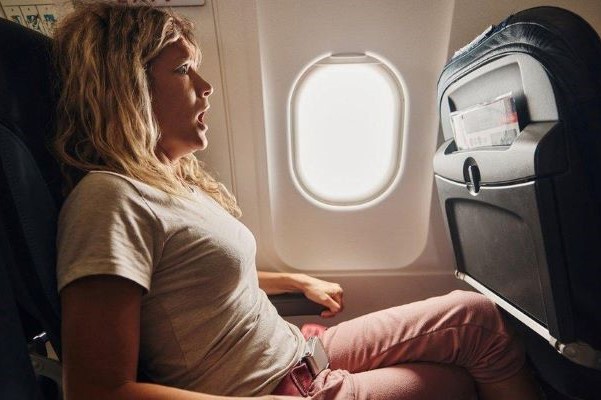
If Flying Is So Safe, Why Are So Many People Afraid of It?
Imagine sitting by the window as the aircraft pushes back from the gate. The cabin lights dim slightly. The engines begin to roar. The runway rushes beneath you. Suddenly, your heart beats faster.
You know the statistics.
You know millions of flights land safely every year.
You know flying is considered one of the safest forms of transportation ever created.
Yet none of that seems to matter.
Get the SkypropreAir Free Travel Pack
Plan smarter, choose a better seat and enjoy a more comfortable long-haul journey. Enter your details below to receive the Travel Pack.
Your palms sweat.
Your stomach tightens.
Your mind starts imagining everything that could go wrong.
This strange contradiction affects millions of people worldwide. Commercial aviation has achieved a remarkable safety record, yet fear of flying remains one of the most common travel anxieties on Earth.
Why?
Why do intelligent, rational people feel terrified stepping onto something that is statistically safer than driving to the airport?
The answer lies deep inside the human brain.
Your Brain Was Never Designed to Understand Flying
For nearly all of human history, humans stayed on the ground.
Our ancestors evolved walking through forests, crossing rivers, and watching for danger from predators. Nothing in our evolutionary history prepared us to travel at 35,000 feet inside a metal tube moving faster than the speed of sound.
Flying feels unnatural because it is unnatural.
Your brain constantly searches for familiar experiences to determine whether something is safe.
When driving a car, your mind understands the environment.
When walking, you understand gravity.
When riding a bicycle, you feel in control.
Inside an aircraft, however, your brain has no comparable reference point.
The experience feels alien.
That unfamiliarity often gets translated into fear.
Related Reading: The Hidden Reason Airplanes Are Safer Than Most People Realize
The Illusion of Losing Control
One of the biggest hidden reasons people fear flying has nothing to do with aircraft.
It has everything to do with control.
When driving a car, you believe you can react to danger.
You can brake.
You can steer.
You can make decisions.
On an airplane, you surrender all control to strangers.
The pilots disappear behind a locked cockpit door.
The aircraft climbs into the clouds.
You cannot stop.
You cannot get off.
You cannot influence what happens next.
For many travelers, this lack of control creates a powerful sense of vulnerability.
Ironically, the very reason aviation is so safe is because trained professionals are handling the situation rather than passengers making decisions themselves.
Travel Comfort Recommendation
Planning a long-haul trip? Compare airline prices and seat options before booking to reduce travel anxiety and improve comfort. (Aviasales)
Fear Doesn’t Understand Statistics
Humans are emotional creatures before they are logical ones.
If fear operated purely on statistics, nobody would be afraid of flying.
Yet people routinely fear airplanes while thinking little about car journeys that are statistically far riskier.
The reason is simple.
The human brain does not evaluate danger mathematically.
It evaluates danger emotionally.
A dramatic plane accident shown repeatedly on television creates a stronger emotional impact than thousands of routine flights landing safely every day.
Our minds remember vivid events.
They often ignore ordinary ones.
As a result, rare aviation incidents feel much more common than they actually are.
The Power of Catastrophic Thinking
Fear of flying often grows from imagination rather than reality.
A slight vibration becomes an imagined mechanical failure.
A strange sound becomes a possible emergency.
A bump of turbulence becomes a disaster scenario.
Psychologists call this catastrophic thinking.
The brain takes a normal event and instantly jumps to the worst possible conclusion.
The challenge is that most passengers have limited understanding of aircraft operations.
Without context, ordinary events can feel alarming.
Yet pilots and flight attendants experience these same events every day without concern.
What feels extraordinary to passengers is often routine to aviation professionals.
Related Reading: The Hidden Mental Pressure Pilots Face Before Every Flight
Why Turbulence Feels So Terrifying
Nothing creates fear faster than turbulence.
One moment the flight is smooth.
The next, the aircraft shakes.
Drinks rattle.
Passengers glance nervously at one another.
For anxious travelers, turbulence feels like danger.
In reality, turbulence is usually no more threatening to an aircraft than potholes are to a car.
Modern airliners are engineered to withstand forces far beyond what passengers encounter during normal flights.
The problem is perception.
Humans associate shaking with loss of control.
When a plane moves unexpectedly, our survival instincts activate.
Your brain interprets movement as a warning signal even when no actual threat exists.
This is why turbulence often feels far worse than it truly is.
Related Reading: The Hidden Reason Turbulence Feels More Terrifying Than It Really Is and Why Even Frequent Flyers Get Nervous During Severe Turbulence
Travel Insurance Placement
Many nervous travelers find peace of mind with comprehensive travel insurance that covers delays, disruptions, medical emergencies, and missed connections. (Affiliate Partner Placement)
The Fear of Heights Comes Along for the Ride
Many passengers who fear flying are not actually afraid of aircraft.
They are afraid of height.
At cruising altitude, an airplane can travel around seven miles above the Earth.
Even though passengers rarely feel that altitude physically, simply knowing how high they are can trigger anxiety.
The mind starts imagining the distance.
The consequences.
The vulnerability.
Yet aviation technology has transformed altitude into something routine.
Pilots, aircraft systems, weather monitoring, and air traffic control work together continuously to maintain safety throughout the journey.
Movies, News, and Social Media Make Fear Worse
Most people have never witnessed an aviation accident.
Yet many feel as if they have.
Why?
Because they have seen countless dramatic portrayals on screens.
Movies often depict terrifying emergencies.
News coverage focuses heavily on rare incidents.
Social media amplifies dramatic footage because fear attracts attention.
The result is a distorted perception of reality.
Millions of successful flights receive almost no coverage.
One unusual event dominates headlines globally.
This imbalance convinces many people that flying is riskier than it truly is.
Related Reading: What Really Happens During an Airline Emergency Evacuation
Your Body Can Trigger Fear Even When Nothing Is Wrong
Sometimes fear of flying starts with physical sensations.
A racing heartbeat.
Sweaty palms.
Shortness of breath.
Tight muscles.
The brain notices these symptoms and assumes danger must be present.
This creates a cycle.
Fear causes physical symptoms.
Physical symptoms create more fear.
More fear produces stronger symptoms.
Soon the passenger feels trapped inside a spiral of anxiety.
Understanding this cycle can be empowering.
Many anxious flyers are reacting not to actual danger but to their body’s stress response.
Why Frequent Flyers Can Still Be Afraid
Surprisingly, experience does not always eliminate fear.
Some frequent travelers remain nervous despite hundreds of flights.
This is because fear is not always based on knowledge.
Sometimes it is based on emotion.
A passenger may understand aviation safety perfectly and still feel anxious during takeoff.
Fear often exists in a different part of the brain than logical reasoning.
Knowledge helps.
But emotional reassurance matters too.
This explains why even experienced travelers occasionally grip their armrests during turbulence.
Related Reading: Why Modern Airports Feel More Emotionally Draining Than Ever
The Hidden Comfort of Understanding How Aviation Works
One of the most effective ways to reduce fear is education.
When passengers understand why engines make certain sounds, why turbulence occurs, or how aircraft systems operate, uncertainty decreases.
And uncertainty is often the fuel that powers anxiety.
Pilots train extensively for emergencies.
Aircraft undergo rigorous inspections.
Air traffic controllers monitor flights continuously.
Modern aviation uses multiple backup systems designed specifically to handle unexpected situations.
The more passengers understand these layers of protection, the easier it becomes to replace fear with confidence.
Fear Is Human—But So Is Trust
Perhaps the most important thing to understand is that fear of flying does not make someone irrational.
It makes them human.
Humans naturally fear situations they cannot fully control.
They fear unfamiliar environments.
They fear uncertainty.
Flying combines all three.
Yet every day, millions of people board aircraft and safely arrive at their destinations.
Behind every takeoff is an extraordinary network of engineers, pilots, mechanics, dispatchers, controllers, and safety professionals working together.
The passenger sees only the cabin.
The aviation industry sees thousands of safety layers operating behind the scenes.
That difference is what makes modern air travel so remarkably safe.
The fear is real.
But so is the safety.
And once people understand why their brains react the way they do, flying often becomes a little less frightening—and a lot more fascinating.
FAQs
1. Why am I afraid of flying even though I know it’s safe?
Fear is driven more by emotion than statistics. Your brain reacts to unfamiliarity, lack of control, and perceived danger even when you logically understand that flying is very safe.
2. Is turbulence dangerous?
In most cases, no. Modern aircraft are built to handle turbulence safely. While it can feel uncomfortable, turbulence rarely poses a threat to the aircraft itself.
3. Can fear of flying be overcome?
Yes. Many people reduce or eliminate flight anxiety through education, exposure, relaxation techniques, and understanding how aviation safety systems work.