
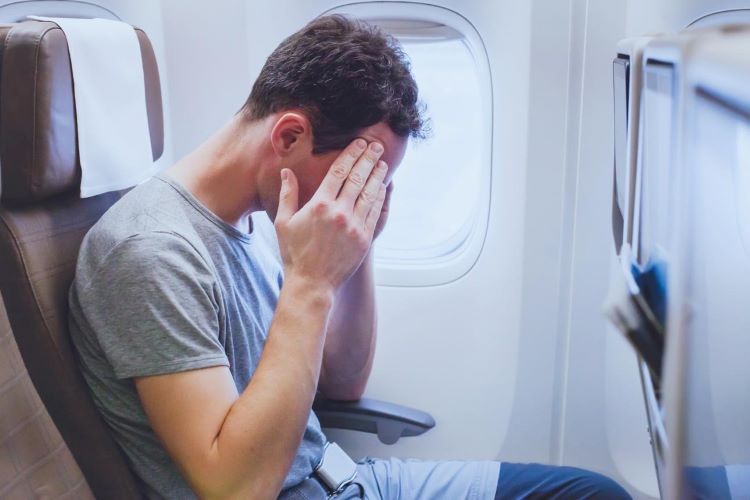
The Hidden Psychology Behind Our Fear of Flying
Imagine sitting comfortably in your seat at 35,000 feet.
The cabin is quiet. The engines hum steadily. Flight attendants move calmly through the aisle serving drinks.
Everything appears normal.
Then the aircraft suddenly shudders.
Your stomach tightens.
Get the SkypropreAir Free Travel Pack
Plan smarter, choose a better seat and enjoy a more comfortable long-haul journey. Enter your details below to receive the Travel Pack.
Your heart races.
Your hands instinctively grip the armrests.
For a brief moment, a terrifying thought flashes through your mind:
“What if something is wrong?”
The surprising truth is that millions of passengers experience this feeling every year—even when the aircraft is operating exactly as designed.
Modern aviation is one of the safest achievements in human history, yet fear of flying remains one of the world’s most common anxieties.
Why?
The answer has less to do with airplanes and more to do with the hidden workings of the human mind.
If you’ve ever questioned airline safety, you may also enjoy The Hidden Reason Airplanes Are Safer Than Most People Realize and What Pilots Know About Turbulence That Most Passengers Don’t.
Your Brain Was Never Designed to Fly
For most of human history, survival depended on staying safely on the ground.
Our ancestors learned to fear heights, falling, uncertainty, and situations they could not control.
Then, within just a tiny fraction of human history, we began climbing into metal tubes and launching ourselves seven miles above the Earth.
From an evolutionary perspective, that’s a shock to the system.
Your brain still carries ancient survival instincts that were designed for forests, mountains, and open plains—not cruising at 550 miles per hour above the clouds.
When you board an aircraft, your subconscious notices something unusual:
You cannot stop.
You cannot get off.
You cannot control the direction.
You cannot see the road ahead.
Your survival instincts immediately become more alert.
That’s where fear often begins.
The Illusion of Control
One of the strongest psychological triggers behind flight anxiety is the loss of control.
Most people feel comfortable driving a car.
Yet statistically, driving is far riskier than flying.
The reason is simple.
When you’re driving, you feel in control.
You hold the steering wheel.
You decide when to brake.
You decide when to turn.
On an airplane, all control belongs to someone you cannot see.
Even though highly trained pilots are operating the aircraft, your subconscious struggles with surrendering responsibility.
For many nervous travelers, the fear isn’t really about crashing.
It’s about helplessness.
It’s about trusting someone else with your safety.
The Fear of the Unknown
Most passengers understand very little about how airplanes work.
That lack of knowledge creates uncertainty.
A strange sound.
A wing flexing.
An engine changing pitch.
A sudden turn after takeoff.
To pilots, these are routine events.
To passengers, they can seem alarming.
The brain naturally fills gaps in knowledge with assumptions.
Unfortunately, those assumptions are often negative.
The less we understand something, the more threatening it appears.
This is why education is one of the most effective ways to reduce flight anxiety.
The more you understand aviation, the less frightening it becomes.
For a deeper understanding, read The Hidden Technology Pilots Depend On Every Day and What All Those Buttons in the Cockpit Really Control.
Travel Smarter and With More Confidence
Many nervous travelers feel more comfortable knowing they’re protected if unexpected travel disruptions occur.
Recommended Resource: SafetyWing Travel Insurance
Why Turbulence Feels So Terrifying
No aspect of flying triggers fear faster than turbulence.
Yet turbulence reveals one of the greatest contradictions in aviation psychology.
Passengers often associate turbulence with danger.
Pilots usually associate it with inconvenience.
The aircraft itself is designed to tolerate forces far greater than ordinary turbulence.
Its wings can flex dramatically without suffering damage.
Engineers have tested aircraft under conditions far more severe than passengers will ever experience.
But your brain doesn’t know that.
Your brain only knows one thing:
Unexpected movement equals potential danger.
The moment the aircraft jolts, your body’s alarm system activates.
Adrenaline floods your bloodstream.
Your breathing changes.
Your muscles tighten.
Your senses become hyper-alert.
The aircraft remains safe.
But your brain reacts as if a threat exists.
That is why turbulence often feels far more dangerous than it really is.
Related Reading:
The Hidden Reason Turbulence Feels More Terrifying Than It Really Is
Why Even Frequent Flyers Get Nervous During Severe Turbulence
The Media Effect Nobody Talks About
When an airplane lands safely, nobody talks about it.
When an aviation incident occurs, it becomes global news.
This creates a powerful psychological distortion.
Psychologists call it the “availability bias.”
The events we remember most easily seem more likely to happen.
Because aviation incidents receive intense media attention, people often overestimate the risk.
Meanwhile, the millions of flights that land safely every year barely receive a mention.
The result?
Our perception becomes disconnected from reality.
The rare begins to feel common.
The unlikely begins to feel probable.
And fear grows stronger.
To better understand emergency situations, read What Really Happens During an Airline Emergency Evacuation, Why Most Passengers Ignore Emergency Exit Instructions, and The Hidden Reason You Must Put Your Own Oxygen Mask On First.
Your Imagination Can Become Your Worst Enemy
One fascinating aspect of human psychology is that the brain often reacts to imagined threats almost as strongly as real ones.
Days before a flight, some travelers begin mentally rehearsing disaster scenarios.
Engine failures.
Severe turbulence.
Emergency landings.
Unexpected events.
Every imagined scenario creates a genuine emotional response.
The body begins preparing for dangers that do not actually exist.
By the time the traveler reaches the airport, their anxiety may already be elevated.
The flight hasn’t even started.
Yet their imagination has already completed the journey.
Why Fear Spreads Through the Cabin
Fear is contagious.
Humans constantly monitor the behavior of people around them.
If another passenger suddenly appears worried, many people become more alert.
If someone gasps during turbulence, nearby travelers often feel more anxious.
Psychologists call this social referencing.
We use the reactions of others to judge potential threats.
This is one reason flight attendants remain calm during turbulence.
Their confidence reassures passengers.
Their behavior sends an important message:
Everything is under control.
Learn more about cabin crew psychology in What Flight Attendants Notice About You Within Seconds of Boarding and Could AI Ever Replace Flight Attendants?
The Hidden Confidence of Professional Pilots
Passengers often see uncertainty.
Pilots see preparation.
Long before carrying passengers, pilots spend years training.
They repeatedly practice emergencies in advanced simulators.
They are evaluated throughout their careers.
Many situations that seem frightening to passengers have already been rehearsed countless times by the flight crew.
This difference in knowledge creates a difference in confidence.
Passengers see risk.
Pilots see procedures.
Passengers see danger.
Pilots see training.
Understanding this reality can dramatically reduce fear.
For more insight, read The Hidden Mental Pressure Pilots Face Before Every Flight and What Pilots Know About Flying That Most Passengers Don’t.
Planning Your Next Flight?
Choosing the right airline, aircraft, and seat can significantly improve your travel experience.
Compare routes, fares, and aircraft types before booking your next journey.
Recommended Resource: Aviasales Flight Search
The Real Battle Happens Inside the Mind
Fear of flying is not weakness.
It is not irrational.
It is a normal human response shaped by evolution, psychology, and perception.
The challenge is that our emotions do not always follow the facts.
The aircraft may be perfectly safe.
The pilots may be highly trained.
The technology may be operating flawlessly.
Yet our brains can still interpret uncertainty as danger.
The hidden psychology behind fear of flying reminds us that the greatest challenge often isn’t trusting the airplane.
It’s trusting reality more than our instincts.
And once we understand that distinction, flying becomes much easier.
You may also enjoy:
• If Flying Is So Safe, Why Are So Many People Afraid of It?
• How Passengers Really React During Aircraft Emergencies
• The Emergency Exit Secret Many Travelers Never Think About
Frequently Asked Questions
Why am I afraid of flying even though I know it’s safe?
Fear of flying is usually linked to loss of control, uncertainty, and natural survival instincts rather than actual danger.
Why does turbulence feel so dangerous?
Unexpected movement triggers the brain’s alarm system, even though modern aircraft are built to withstand far more turbulence than passengers typically experience.
Can people overcome a fear of flying?
Yes. Education, repeated exposure, understanding aviation procedures, and learning relaxation techniques can significantly reduce flight anxiety.
Join the Conversation
If statistics prove that flying is safer than driving, why do you think so many intelligent, experienced, and rational people still fear it? Is the fear really about flying—or is it about our struggle to surrender control and trust something we cannot see?