
Aircraft Safety Testing: Extreme Tests Before You Fly
Before You Fly: The Extreme Tests Every Aircraft Must Survive
Before an Aircraft Carries You, Engineers Push It Towards Its Limits
Imagine a brand new passenger aircraft.
The seats are spotless.
The engines have barely accumulated any hours.
The aircraft has never carried a paying passenger.
But instead of treating this multimillion-dollar machine gently, engineers subject its design to conditions that can look astonishing.
Get the SkypropreAir Free Travel Pack
Plan smarter, choose a better seat and enjoy a more comfortable long-haul journey. Enter your details below to receive the Travel Pack.
Wings may be loaded until they bend dramatically.
Engines are tested against bird ingestion and other hazards.
Aircraft systems are evaluated for icing conditions.
Electrical systems must be protected against the effects of lightning.
Brakes and take-off performance are assessed against demanding certification requirements.
And test pilots deliberately explore areas of the aircraft’s operating envelope that ordinary airline passengers may never experience.
Why?
Because before an aircraft type enters commercial service, its manufacturer must demonstrate that the design complies with extensive airworthiness requirements.
In the United States, the Federal Aviation Administration describes aircraft certification as a rigorous, multi-phase process covering standards, design definition, detailed compliance work, building, testing, certification and production. Europe has a comparable system overseen by EASA.
Aircraft safety testing is therefore one of the largely invisible reasons you can board an airliner, buckle your seat belt and watch it climb towards 38,000 feet with confidence.
And some of those tests are extraordinary.
Protect Every Journey
Unexpected delays, medical emergencies or lost baggage can affect even the best-planned trips.
👉 Travel with confidence by protecting your journey with SafetyWing Travel Insurance.
1. Bird Ingestion: What Happens When a Bird Meets a Jet Engine?
A bird disappearing into a jet engine sounds like the beginning of an aviation disaster.
Engine manufacturers have to consider that possibility long before the aircraft enters airline service.
Turbine engines are subject to specific bird-ingestion certification requirements. In the United States, for example, FAA regulations establish bird-ingestion requirements for turbine aircraft engines, with detailed certification guidance covering how compliance can be demonstrated.
Testing can involve representative bird carcasses being introduced into operating engines under controlled conditions.
But an important distinction is often lost in dramatic videos online.
The requirement isn’t simply that an engine must swallow any bird of any size and continue operating normally.
Certification criteria vary according to factors including bird size, number, engine characteristics and test condition. The required outcome can also differ depending on the applicable test.
What engineers want to understand is how the engine behaves when suddenly subjected to an impact it could realistically encounter in service.
It is a violent test.
But it is conducted so that the first time engineers learn how an engine responds to such an event isn’t with passengers sitting behind it.
Related Reading: The Most Dangerous Phase of Every Flight
2. Ice: Testing Against an Invisible Enemy
Ice can fundamentally alter how air flows around an aircraft.
Accumulation on wings and other critical surfaces can affect aerodynamic performance, while ice entering an engine presents additional challenges.
That is why aircraft intended for operation in icing conditions must demonstrate appropriate capabilities.
Testing and certification can involve sophisticated simulations, ground facilities and flight testing under appropriate conditions.
Aircraft also use systems designed to prevent or remove dangerous ice accumulation from critical areas.
The issue is taken seriously enough that operational rules require aircraft intentionally flown into expected or actual icing conditions to be appropriately certified and equipped.
And certification standards continue to evolve as scientists and regulators improve their understanding of phenomena such as supercooled large droplets and ice crystals.
So when you look through your window on a freezing winter flight and see an aircraft being de-iced before departure, you’re witnessing one small part of a much larger aviation strategy for controlling the dangers associated with ice.
Related Reading: What happens during an aircraft stall
3. Heavy Rain, Water and Hail
An airliner cannot choose to operate only beneath perfect blue skies.
During decades of service, an aircraft may encounter torrential rain, storms and other demanding weather conditions.
Its structure, engines, sensors, windshields and other components therefore have to be designed with environmental hazards in mind.
Testing can involve simulated rain, water ingestion and impact testing of vulnerable components where applicable.
Think about the aircraft windshield directly in front of the pilots.
At cruising speeds, it isn’t simply a piece of glass.
It is an engineered, layered structure designed to withstand substantial loads while maintaining the visibility and structural performance required for safe operation.
The same philosophy extends throughout the aircraft: assume the environment will sometimes be hostile—and design accordingly.
Related Reading: Why some aircrafts feel calmer in turbulence
4. Sand and Dust: When the Air Itself Becomes Abrasive
Aircraft don’t operate only from temperate European or North American airports.
Some spend their lives flying through regions where dust and sand are routine environmental challenges.
Fine particles can be particularly troublesome for turbine engines.
They can contribute to erosion, contaminate components and, in severe environments, affect engine performance.
Manufacturers therefore evaluate how engines and aircraft systems cope with environmental contaminants relevant to their intended operation.
This is also an example of why aircraft safety testing doesn’t end when an aircraft receives its original certificate.
Information collected from real-world operations can contribute to maintenance requirements, inspections, modifications and continuing-airworthiness actions throughout an aircraft’s service life.
Related Reading: Best seats by aircraft type
5. Fire: Designing for the Emergency Nobody Wants
Fire is among the most serious hazards aboard an aircraft.
The aviation response is not based on assuming fire will never happen.
It is based on layers of protection.
Aircraft designs incorporate fire detection, containment, suppression and fire-resistant materials in critical areas according to applicable requirements.
Engine installations, cargo compartments and other designated areas have specific protection considerations.
The philosophy is important.
If something fails, the aircraft should not depend upon a single protective barrier.
Engineers instead use multiple layers of defence intended to detect a problem, contain its consequences and give the crew the capability and time needed to respond.
That’s a principle you’ll find repeatedly throughout aviation:
Don’t simply ask, “Will this component fail?”
Ask:
“If it does fail, what happens next?”
👉 Compare prices with Aviasales to find competitive fares before your next trip.
6. Wing Testing: Watching a Giant Wing Bend
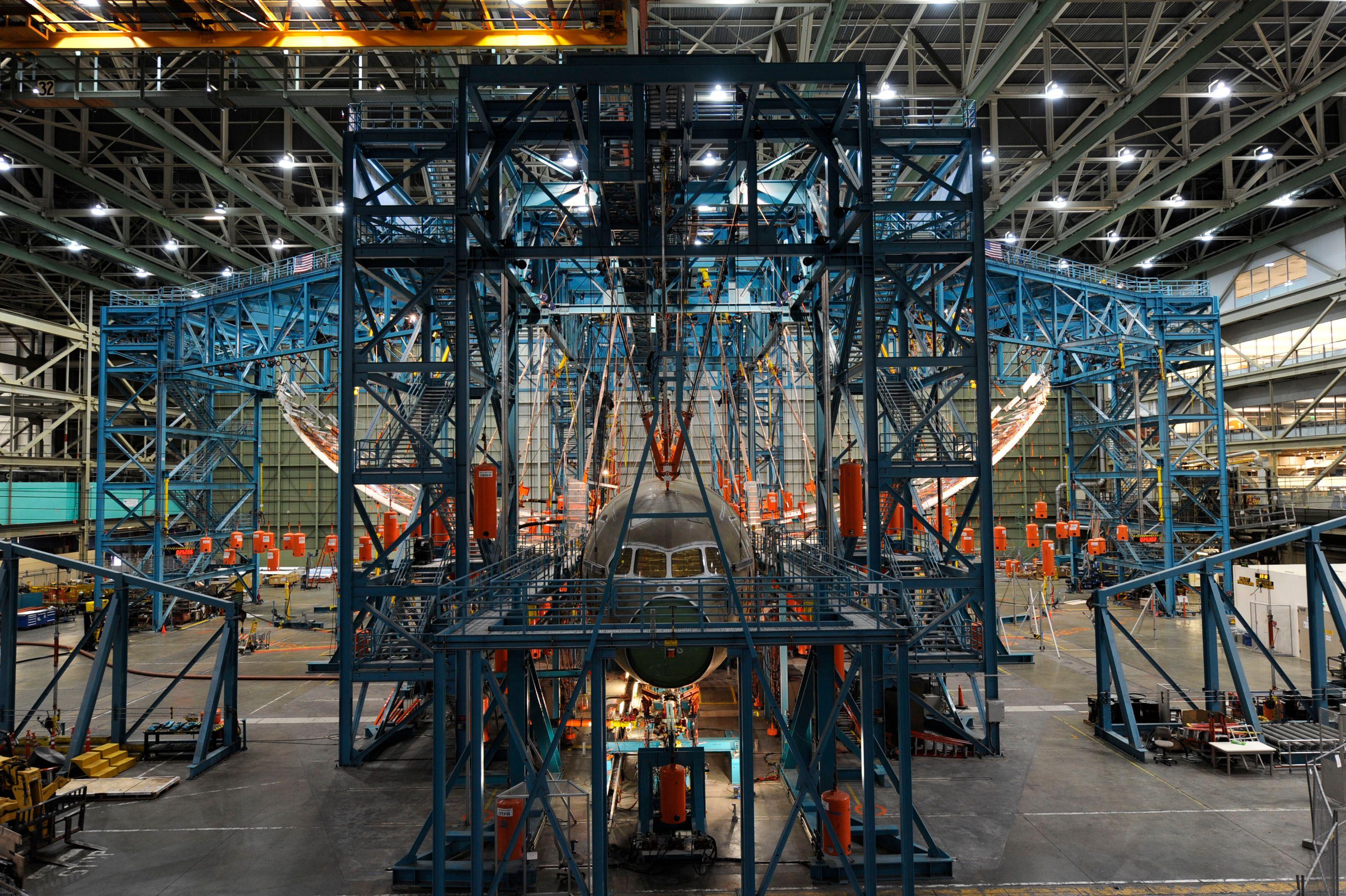
This is perhaps one of the most spectacular sights in aircraft development.
During structural testing, enormous loads can be applied to an aircraft wing.
The wing bends.
Then it bends further.
To someone unfamiliar with aircraft engineering, the deformation can look terrifying.
But aircraft wings aren’t intended to behave like rigid concrete beams.
They are engineered structures capable of flexing under aerodynamic loads.
Structural certification requires manufacturers to demonstrate that the aircraft can withstand prescribed loads with appropriate margins.
That’s why dramatic photographs of wings flexing during testing don’t necessarily show an aircraft close to an unexpected catastrophe.
They show engineers gathering evidence about exactly what the structure can withstand.
That flexibility is particularly noticeable on modern composite aircraft such as the Boeing 787 Dreamliner.
Wing-load trials are among the most visually dramatic forms of aircraft safety testing.
For passengers, the important lesson is counterintuitive:
A wing moving in turbulence isn’t automatically a sign of weakness. Flexibility is part of the engineering.
Related Reading: Boeing 787 Dreamliner wings are designed to flex significantly
7. Lightning: What If the Aircraft Is Struck at 35,000 Feet?
Few things sound more alarming than lightning striking an aircraft.
Yet designers have been dealing with this phenomenon for decades.
Modern aircraft must incorporate protection against both the direct and indirect effects of lightning.
That challenge has become particularly interesting as aircraft have incorporated increasing amounts of composite material and sophisticated electronics.
Certification methods include evaluating lightning environments, aircraft lightning zones, test waveforms, direct effects and protection of electrical and electronic systems. FAA guidance specifically addresses demonstrating compliance with these requirements.
Engineers want lightning energy to travel through or around the aircraft in controlled ways without creating unacceptable hazards to occupants, fuel systems or critical electronics.
So while a lightning strike may produce a dramatic flash or loud bang that frightens passengers, the possibility of lightning is not something aircraft designers forgot to consider.
It is built into the certification philosophy.
Lightning protection demonstrates how aircraft safety testing prepares airliners for hazards passengers may rarely consider.
Related Reading: The Hidden Engineering Behind Aircraft Passenger Doors
8. Rejected Take-Off: Can the Aircraft Stop in Time?
Now imagine an aircraft accelerating along a runway.
It is heavy.
The engines are producing enormous thrust.
The speed continues increasing.
And then the take-off must be rejected.
Stopping a heavily loaded aircraft from high speed converts a tremendous amount of kinetic energy into heat, much of it absorbed by the braking system.
Take-off certification therefore considers not only whether an aircraft can accelerate into the sky, but also the conditions under which it must be capable of safely stopping.
FAA transport-category certification standards address rejected-take-off performance and accelerate-stop distances.
Braking systems must cope with demanding energy loads and manufacturers perform extensive testing to demonstrate performance.
The wheels and brakes can become extraordinarily hot.
High-energy braking trials are another critical part of aircraft safety testing before a new design enters airline service.
Yet this is exactly the type of scenario engineers need to understand before an aircraft begins routine passenger operations.
9. Extreme Heat and Freezing Cold
An airliner might spend the morning sitting on a runway in intense desert heat.
Hours later, it could be cruising through an atmosphere where outside temperatures are far below freezing.
Later still, it may land at an airport experiencing snow and ice.
Aircraft components therefore have to operate across demanding environmental ranges.
Manufacturers use environmental testing to evaluate equipment, materials and systems under temperature extremes and other conditions they may encounter throughout the aircraft’s operating life.
Electronics must function.
Hydraulic and other systems must perform within their approved limits.
Materials must tolerate repeated environmental cycles.
Because an aircraft isn’t designed for one perfect afternoon.
It is designed for years of operations across continents and climates.
10. Crosswinds and Flight Testing: Taking the Aircraft Into the Real World
Eventually, simulations and laboratories aren’t enough.
The aircraft has to fly.
Test pilots and flight-test engineers undertake programmes designed to demonstrate handling characteristics, system behaviour, performance and compliance across the required operating envelope.
They may evaluate stalls and low-speed handling.
They test take-offs and landings.
They examine system failures and abnormal conditions.
They gather enormous quantities of data.
Crosswind testing is another highly visible part of aircraft development and certification.
Watching a large airliner approach a runway while pointed noticeably into the wind can look uncomfortable from the ground.
Some of the most demanding aircraft safety testing happens not in laboratories, but in the sky.
For flight-test crews, however, these flights provide critical information about how the aircraft behaves near its demonstrated operating limits and help establish the information pilots will later use in airline service.
But Certification Isn’t One Giant Torture Test
This distinction matters.
Online videos sometimes create the impression that regulators simply take a completed aircraft and try to destroy it.
The reality is much more sophisticated.
Certification begins much earlier.
Design calculations, computer modelling, laboratory experiments, component testing, structural tests, simulations, ground tests and flight tests can all contribute to demonstrating compliance.
Regulators review how manufacturers intend to show that their designs meet applicable standards.
The FAA says its Aircraft Certification Service includes more than 1,300 engineers, scientists, inspectors, test pilots and other safety professionals involved in oversight of aircraft design, production and continued airworthiness.
EASA similarly requires applicants to demonstrate compliance with applicable requirements before a new aircraft type receives its Type Certificate.
And certification isn’t the end of the story.
Aircraft remain subject to continuing-airworthiness oversight after entering service.
Importantly, aircraft safety testing is only one part of the much broader certification process.
Lessons from operations can lead to inspections, maintenance changes, modifications or mandatory airworthiness directives.
What All This Means for the Passenger in Seat 32A
Most passengers will never see any of this.
You see the finished aircraft.
You walk through the boarding door.
You place your bag in the overhead locker.
You sit down.
Perhaps you look through the window at the wing without realizing what that structure had to demonstrate before an aircraft of that design was approved.
Then turbulence begins.
The wing flexes.
Rain pounds against the window.
Perhaps lightning illuminates the cabin.
And suddenly the aircraft doesn’t feel quite as invincible as it did at the gate.
But behind that ordinary passenger experience sits decades of accumulated engineering knowledge, regulation, testing and lessons learned from previous generations of aircraft.
Behind every routine passenger flight lies years of aircraft safety testing, engineering analysis and regulatory scrutiny.
No engineering system can make aviation completely risk-free.
Aircraft can still experience failures, severe weather and unexpected events.
But modern aviation approaches those risks by identifying hazards, testing designs against demanding requirements and building multiple layers of protection.
The Aircraft Had to Prove Itself Before You Ever Stepped Aboard
Next time you board a commercial aircraft, look around for a moment.
Look at the engines.
Look at the wings.
Look at the windows.
Look at the doors.
Almost everything you can see and countless systems hidden beneath the floor, behind the walls and inside the cockpit exists within an enormous engineering and certification framework.
Long before you fastened your seat belt, engineers had already asked difficult questions.
What happens if a bird enters the engine?
What happens in ice?
What happens if lightning strikes?
What happens if a system fails?
What happens if the pilots have to stop during take-off?
And then they had to demonstrate that the aircraft’s design met the applicable safety requirements.
That is one of the remarkable things about commercial aviation.
The safest flight isn’t created when everything goes perfectly.
It is created by preparing for the moments when everything doesn’t.
Frequently Asked Questions
Are aircraft actually tested until their wings break?
Structural test programmes may load test articles to very high levels to demonstrate required strength and margins. Some development programmes may continue testing beyond certification requirements to understand structural behaviour, but that should not be confused with every production aircraft being deliberately taken to destruction.
Can a passenger aircraft survive a lightning strike?
Aircraft are designed with lightning protection, and certification requirements address both direct effects and protection of critical electrical and electronic systems.
Do aircraft engines really undergo bird-strike tests?
Yes. Turbine aircraft engines are subject to bird-ingestion certification requirements. However, the precise test conditions and required outcomes depend on the applicable certification criteria; it isn’t simply a requirement that every engine ingest any bird and continue operating normally.