
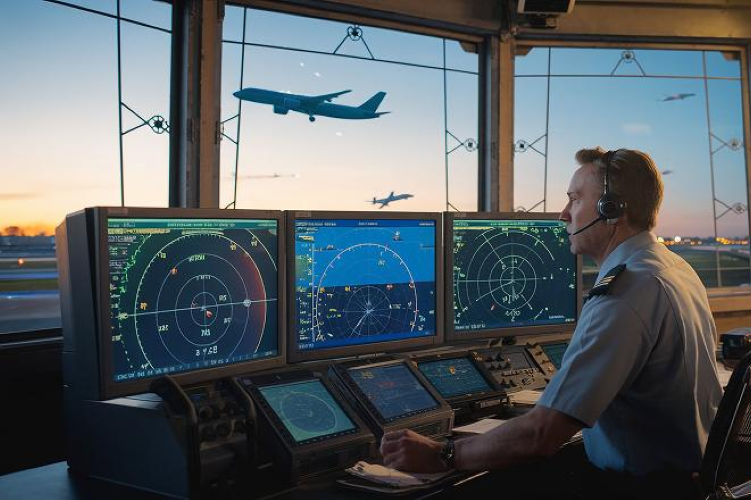
How Radar Really Tracks Airplanes Across the World
Every Second, Thousands of Aircraft Vanish… Yet Controllers Never Lose Them
Imagine standing outside on a clear night.
You look up and see nothing.
No flashing lights.
No engines.
No sign that a Boeing 777 is crossing overhead at nearly 600 mph.
Get the SkypropreAir Free Travel Pack
Plan smarter, choose a better seat and enjoy a more comfortable long-haul journey. Enter your details below to receive the Travel Pack.
Yet somewhere, an air traffic controller knows almost exactly where that aircraft is.
Its altitude.
Its speed.
Its direction.
Even the unique identity of the airplane.
How?
Most people imagine a giant spinning radar dish magically watching every aircraft on Earth.
The truth is far more fascinating.
Radar is only one piece of an enormous global surveillance system—one that combines radio waves, satellites, onboard computers, GPS, and thousands of highly trained professionals working together around the clock.
Without it, modern aviation simply could not exist.
Here’s how the invisible network really keeps the world’s skies safe.
Related Reading: The Hidden Science Behind Aircraft Oxygen Masks, The Most Dangerous Phase of Every Flight, and What Happens During an Aircraft Evacuation at Night?
The Original Eye in the Sky
Radar—short for Radio Detection and Ranging—was developed before World War II and quickly became one of the most important technologies ever created.
Its principle is surprisingly simple.
A rotating antenna sends out powerful bursts of radio energy.
When those waves strike an object, part of the signal bounces back.
By measuring how long the signal takes to return, computers calculate the aircraft’s distance.
The antenna’s direction reveals its bearing.
Together, they show where an aircraft is located.
That revolutionary invention forever changed aviation.
Primary Radar: Finding Aircraft Without Their Help
The earliest air traffic radars use Primary Surveillance Radar (PSR).
Primary radar does not require any equipment on the aircraft.
It simply detects anything that reflects radio waves.
This means it can locate:
-
Commercial airliners
-
Private aircraft
-
Military jets
-
Helicopters
-
Weather balloons
-
Even large flocks of birds
Its greatest advantage is independence.
Even if an aircraft’s electronics fail, primary radar may still detect it.
The downside?
It only tells controllers that something is there.
It cannot identify the aircraft or reveal its altitude.
Secondary Radar: When Aircraft Answer Back
Modern aviation relies heavily on Secondary Surveillance Radar (SSR).
Instead of waiting for reflected radio waves, the ground radar sends an electronic interrogation.
The aircraft’s transponder immediately replies.
Within milliseconds, controllers receive information including:
-
Flight number
-
Altitude
-
Aircraft identity
-
Squawk code
-
Additional flight information
Instead of simply seeing an unknown dot, controllers see a labelled aircraft moving across their screens.
That dramatically improves both safety and efficiency.
You May Also Enjoy: Why Passenger Planes Fly at 35,000 Feet Instead of 10,000 Feet and What Sunrise Looks Like From a Cockpit at 39,000 Feet.
Planning Your Next Flight?
Whether you’re travelling for business or adventure, compare fares across hundreds of airlines before booking. Check the latest flight deals through our trusted partner Aviasales and see if you can save on your next journey.
The Secret Device Every Airliner Carries
Hidden inside every commercial aircraft is a transponder.
Think of it as the airplane’s electronic passport.
Whenever radar asks, it responds instantly.
Modern Mode S transponders transmit significantly more information than earlier generations, helping controllers manage increasingly crowded skies safely.
Radar Doesn’t Cover the Entire Planet
This surprises many travellers.
There is no worldwide radar coverage.
Building radar stations every few hundred kilometres across the oceans would be impossible.
That leaves enormous regions where traditional radar simply cannot reach.
Examples include:
-
The middle of the Atlantic Ocean
-
Large parts of the Pacific
-
Remote Arctic regions
-
Vast deserts
-
Isolated wilderness
For decades, this represented one of aviation’s greatest challenges.
So how are aircraft tracked there?
GPS Changed Everything
Today’s airliners constantly calculate their own position using Global Navigation Satellite Systems (GNSS), including GPS.
Instead of waiting for radar to locate them, aircraft know exactly where they are.
That paved the way for one of aviation’s greatest technological advances.
ADS-B: Aircraft That Announce Their Own Position
Automatic Dependent Surveillance–Broadcast (ADS-B) changed aircraft tracking forever.
Instead of waiting for radar interrogation, aircraft automatically broadcast:
-
GPS position
-
Altitude
-
Ground speed
-
Direction
-
Aircraft identification
These broadcasts occur several times every second.
Ground stations receive them and forward the information directly to air traffic control.
Many popular flight-tracking websites also rely heavily on ADS-B receivers.
Related Reading: Why the Airbus A380 Is Still the World’s Favorite Airplane and The Part of the Aircraft That Feels Turbulence the Most.
Satellites Closed the World’s Biggest Blind Spots
The next breakthrough came from space.
Satellites began receiving ADS-B transmissions directly from aircraft flying across oceans and remote areas.
Instead of disappearing for hours over the Atlantic, many aircraft now remain visible throughout most of their journey.
This has dramatically improved:
-
Flight monitoring
-
Search-and-rescue capability
-
Air traffic management
-
Long-haul operational efficiency
Travel Smarter and Stay Protected
International travel doesn’t always go as planned. Delays, medical emergencies, and lost baggage can happen anywhere.
Before your next trip, compare affordable travel insurance through SafetyWing—trusted by thousands of international travellers and digital nomads.
Why Controllers Keep Aircraft Far Apart
People often ask why aircraft don’t fly closer together.
The answer is simple:
Safety.
Controllers maintain minimum separation standards that account for:
-
Navigation accuracy
-
Weather
-
Communication delays
-
Pilot reaction time
-
Equipment failures
-
Unexpected emergencies
Even when aircraft appear close together on flight-tracking apps, they remain separated by carefully calculated safety margins.
Weather Radar Is a Completely Different System
Passengers often confuse weather radar with air traffic radar.
They perform entirely different jobs.
Ground surveillance radar tracks aircraft.
The weather radar in an aircraft’s nose detects precipitation and thunderstorms ahead, helping pilots avoid hazardous weather.
One watches airplanes.
The other watches storms.
What Happens If Radar Stops Working?
Modern aviation is designed with multiple backup systems.
If one radar fails, controllers can rely on:
-
Nearby radar installations
-
ADS-B
-
Satellite surveillance
-
Pilot position reports
-
Procedural separation
-
Alternative communication systems
Flights do not suddenly become unsafe.
Controllers simply increase separation distances while maintaining safe operations.
This layered approach is one of aviation’s greatest strengths.
Continue Exploring: The Hidden Science Behind Aircraft Oxygen Masks, Why Flight Attendants Sit on Their Hands During Takeoff, and The Passenger Habit Flight Attendants Find Most Frustrating.
Artificial Intelligence Is Becoming Aviation’s Next Pair of Eyes
Artificial intelligence is beginning to transform air traffic management.
Future systems can help detect unusual aircraft behaviour, predict potential conflicts, optimise traffic flow, and support controllers during periods of heavy demand.
Rather than replacing controllers, AI is becoming another powerful safety tool.
The Invisible Network That Protects Millions Every Day
Every commercial flight depends on an extraordinary partnership between technology and people.
Primary radar detects.
Secondary radar identifies.
Transponders respond.
GPS calculates position.
ADS-B broadcasts it.
Satellites extend surveillance beyond land.
Controllers combine all of that information to guide thousands of aircraft safely through crowded skies every single day.
The next time you open a flight-tracking app and watch an aircraft crossing an ocean, remember:
You are witnessing one of the greatest engineering achievements in human history.
An invisible global network quietly protects millions of passengers every single day.
Most travellers never think about it.
Every air traffic controller does.
Conclusion
Radar may have begun as a wartime invention, but today it forms the backbone of one of the safest transportation systems ever created. Combined with satellites, GPS, ADS-B, and skilled air traffic controllers, it allows more than one hundred thousand flights to operate safely around the globe each day.
The remarkable part isn’t just that airplanes fly.
It’s that thousands of them can fly simultaneously—often only minutes apart—without passengers ever realising the invisible choreography taking place behind the scenes.
Frequently Asked Questions
Can radar track aircraft anywhere in the world?
No. Ground-based radar has limited range, especially over oceans. Satellite-based ADS-B now helps monitor aircraft across much of the world’s remote airspace.
Why do aircraft disappear from flight-tracking apps?
Temporary gaps can occur because of limited ADS-B receiver coverage, signal interruptions, or data delays. Air traffic control often continues to track the aircraft using multiple surveillance systems.
Is GPS replacing radar?
No. GPS complements radar rather than replacing it. Modern aviation combines radar, GPS, ADS-B, satellites, and radio communications to create several overlapping layers of safety.
Join the Conversation
Before reading this article, did you think a giant radar covered the entire planet—or were you surprised to learn that much of the world’s aircraft tracking now depends on satellites and aircraft broadcasting their own position?
Share your answer in the comments below. We’d love to hear your thoughts and experiences using flight-tracking apps.