
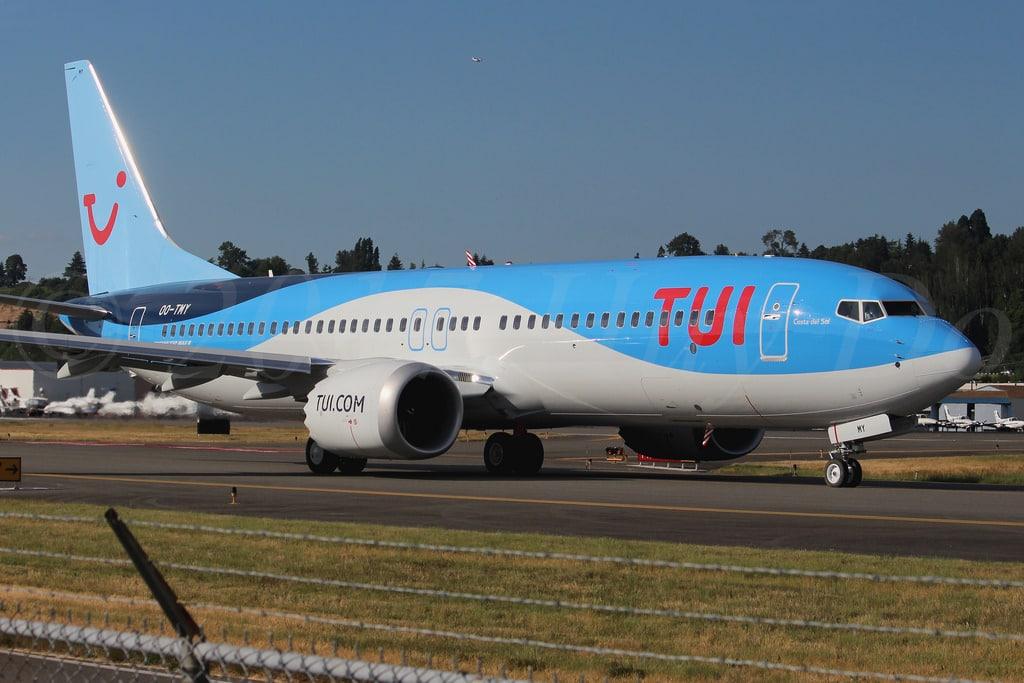
One Man Walked Onto Manchester Airport’s Airfield — Then a TUI Flight Declared Mayday
It lasted only about 15 minutes.
But for passengers sitting aboard aircraft approaching Manchester Airport, those minutes suddenly mattered.
The Manchester Airport security breach began late on Friday night when an unauthorised man gained access to the airport’s airfield.
The response was immediate.
Aircraft movements were temporarily halted. Incoming flights began holding. Others diverted.
Get the SkypropreAir Free Travel Pack
Plan smarter, choose a better seat and enjoy a more comfortable long-haul journey. Enter your details below to receive the Travel Pack.
And then one aircraft approaching Manchester faced a very different problem:
fuel.
A TUI Boeing 737 MAX 8 arriving from Boa Vista in Cape Verde eventually declared an emergency and diverted to East Midlands Airport.
It sounds extraordinary.
How can one person getting onto an airport airfield ultimately contribute to an airliner declaring Mayday?
The answer reveals something fascinating about how airlines plan fuel and why pilots don’t simply circle an airport indefinitely waiting for it to reopen.
What Happened at Manchester Airport?
The incident began at approximately 11:21 p.m. on Friday, 21 August, when a man gained unauthorised access to the airside area at Manchester Airport.
Airport operations were temporarily stopped while authorities responded.
The man was apprehended and arrested, and police subsequently said the incident appeared to be mental-health related. He was taken to hospital for assessment.
The airfield was closed for approximately 15 minutes.
That doesn’t sound particularly long.
But airports operate on tightly coordinated arrival and departure sequences.
When a major airport suddenly stops accepting aircraft, planes already approaching don’t simply stop in the sky.
They have to go somewhere.
Seven Flights Diverted — And Others Started Circling
Reports said seven incoming flights were diverted, while approximately 17 others were held in the air.
Some aircraft entered holding patterns while crews waited for Manchester to become available again.
Others were sent to alternative airports including East Midlands, Birmingham, Liverpool and Leeds Bradford.
For passengers, it meant unexpected arrivals hundreds of kilometres from where they expected to land.
But for pilots, another calculation had already begun.
How long can we safely wait?
Because every minute an aircraft spends holding burns fuel.
Then TUI Flight TOM439 Faced a Decision
Among the affected aircraft was TUI flight TOM439, travelling from Boa Vista in Cape Verde to Manchester.
After a long flight, the Boeing 737 MAX 8 was approaching its destination when the disruption occurred.
The aircraft entered a holding pattern.
But unlike a car waiting in traffic, an aircraft cannot simply wait indefinitely.
Its crew must continuously assess the fuel remaining against several possibilities:
- continuing to hold;
- making another approach;
- diverting to an alternate airport;
- and landing with the required fuel reserves intact.
Eventually, TOM439 declared an emergency associated with its fuel situation and diverted to East Midlands Airport.
The aircraft landed safely.
But the word Mayday understandably sounds alarming.
So what does a fuel Mayday actually mean?
Does a Fuel Mayday Mean the Plane Is About to Run Out of Fuel?
No.
This distinction is extremely important.
Aviation emergencies can sound far more frightening to passengers than the procedures behind them. The same principle applies to other scenarios, including engine problems, where aircraft are designed with multiple layers of redundancy and contingency planning.
A pilot declaring a fuel emergency does not necessarily mean the engines are about to stop.
Aviation fuel planning deliberately incorporates reserves precisely because unexpected events happen.
Weather changes.
Runways close.
Aircraft go around.
Airports become unavailable.
And occasionally, someone gets somewhere they absolutely shouldn’t be.
When the crew determines that the aircraft’s predicted landing fuel is approaching critical regulatory reserves, declaring an emergency tells air traffic control:
This aircraft can no longer accept unnecessary delay.
It gives the flight priority.
That’s not evidence that aviation’s safety system has failed.
In many respects, it’s evidence that the system is working.
Why Didn’t the TUI Flight Just Wait Another 15 Minutes?
This is where hindsight can be misleading.
We now know the Manchester closure lasted approximately 15 minutes.
The pilots in the air couldn’t necessarily know exactly how long the disruption would last.
Imagine being told:
“Airport temporarily closed due to a security incident.”
Will it reopen in five minutes?
Fifteen?
Thirty?
An hour?
A flight crew cannot base a safety-critical fuel decision on hope.
At some point, the aircraft must leave the holding pattern while it still has sufficient fuel to reach an alternate airport safely.
Waiting too long could remove that option.
That’s why a diversion that later appears unnecessary can actually represent good decision-making at the time.
Why Aircraft Carry Reserve Fuel
Airliners don’t normally take off carrying only enough fuel to fly from Airport A to Airport B.
Flight planning accounts for additional fuel requirements and contingencies.
Exactly how fuel is calculated depends on the operation and applicable regulations, but the principle is simple:
The aircraft needs options when the original plan stops working.
Those reserves may have to account for unexpected delays, weather, diversion requirements and final reserve fuel.
And that final reserve isn’t supposed to become extra holding fuel simply because passengers and airlines would prefer to reach the original destination.
Once the situation reaches the appropriate threshold, the crew must act.
“Minimum Fuel” and “Mayday Fuel” Aren’t the Same Thing
This is another distinction passengers rarely hear about.
A crew can advise air traffic control of minimum fuel when the aircraft’s fuel situation has reached the point where additional unexpected delay could become problematic.
But that isn’t necessarily an emergency declaration.
A Mayday fuel declaration is more serious.
It indicates that the crew predicts the aircraft will land with less than the required final reserve fuel.
The declaration allows air traffic controllers to recognise the urgency and give the aircraft the priority it needs.
So hearing the word “Mayday” doesn’t mean panic in the cockpit.
It means the crew is communicating the situation using established aviation procedures.
The Extraordinary Chain Reaction
Perhaps the most remarkable part of the Manchester Airport security breach is how quickly one event can propagate through an aviation network.
One person enters a restricted airfield.
The airport temporarily stops aircraft movements.
Arriving aircraft begin holding.
Holding aircraft burn additional fuel.
Some crews reach their predetermined diversion points.
Aircraft leave for alternate airports.
One flight’s fuel situation becomes sufficiently urgent for the crew to declare an emergency.
And passengers who expected to step off an aircraft in Manchester suddenly find themselves somewhere else.
All from an incident lasting around 15 minutes.
That’s the reality of modern aviation.
The system is enormously efficient but safety depends on every part of it working within carefully protected margins.
Why Closing the Airport Was the Right Decision
It might be tempting to ask why aircraft couldn’t simply continue landing while security personnel dealt with the intruder.
The answer is straightforward:
Nobody can safely assume what an unauthorised person on an operational airfield will do next.
Runways and taxiways are environments where aircraft weighing tens or hundreds of tonnes may be travelling at considerable speed.
Until authorities know the airfield is secure, suspending movements removes an unacceptable uncertainty.
The resulting delays and diversions are inconvenient.
But inconvenience is preferable to gambling with an unknown hazard.
What Passengers Can Learn From This Incident
There’s also an important lesson here for passengers.
When your aircraft suddenly starts circling near its destination, it doesn’t automatically mean something is wrong with the plane.
Holding patterns happen for many reasons:
weather, congestion, runway inspections, emergencies, air traffic restrictions and as Manchester demonstrated—security incidents.
Weather can create another kind of unexpected disruption in the air, particularly when turbulence develops with little warning. Our guide to why turbulence can strike without warning explains what passengers should know when conditions suddenly change.
Likewise, a diversion doesn’t necessarily indicate that passengers were in immediate danger.
Sometimes the safest decision pilots can make is simply:
stop waiting and go somewhere else.
Flying soon? Unexpected diversions, delays and airport disruptions are part of air travel. Before your next trip, compare flight options and routes so you know what alternatives are available.
Compare flights with Aviasales
The SkypropreAir Verdict
“The Manchester Airport security breach demonstrates something passengers rarely get to see:”
aviation safety margins in action.
Those safety margins begin long before an aircraft carries passengers. Modern airliners undergo extensive testing before entering service, including extreme conditions most passengers will never encounter.
A security breach shut the airfield temporarily.
Aircraft held.
Pilots monitored their fuel.
Several diverted.
And when one crew determined its fuel situation required priority, it declared an emergency and landed safely at an alternate airport.
The dramatic part of this story isn’t simply that a TUI aircraft declared Mayday.
It’s that the pilots didn’t wait until they were out of options.
That’s exactly what fuel reserves, alternate airports and emergency declarations are designed to prevent.
Frequently Asked Questions
Why did Manchester Airport close?
The airfield temporarily closed after an unauthorised person gained access to the restricted airside area. Authorities apprehended the individual and operations subsequently resumed.
Did the TUI aircraft run out of fuel?
No. The aircraft landed safely at East Midlands Airport. A fuel-related emergency declaration does not mean an aircraft has exhausted its fuel; it gives the crew priority when the remaining fuel margin has become operationally critical.
Why do planes divert instead of waiting for an airport to reopen?
Pilots don’t know precisely how long an unexpected closure will last. They must preserve enough fuel and operational margin to reach a suitable alternate airport rather than continue holding until their options disappear.
If you were on a flight circling your destination, would you rather the pilots wait longer for the airport to reopen or divert early while they still have plenty of options?