
Air France Flight 447: How the Tragedy Changed Aviation
Seventeen Years Later, a Landmark Verdict Arrived. But Aviation Had Already Changed Forever.
For nearly two decades, the families of the 228 people aboard Air France Flight 447 waited for answers.
On 21 May 2026, the Paris Court of Appeal convicted both companies of involuntary/corporate manslaughter, reversing their 2023 acquittals. Both were fined €225,000. Airbus subsequently announced an appeal to the Court of Cassation.
But while the legal battle continued in courtrooms, something else had already happened.
The aviation industry had quietly transformed itself.
The lessons learned from Flight 447 helped reshape pilot training, unreliable-airspeed procedures and the aviation industry’s understanding of automation and high-altitude stall recovery.
If you’ve flown on an Airbus, Boeing, or any modern airliner over the past decade, chances are you’ve benefited from safety improvements inspired by this tragedy.
Get the SkypropreAir Free Travel Pack
Plan smarter, choose a better seat and enjoy a more comfortable long-haul journey. Enter your details below to receive the Travel Pack.
This isn’t just the story of a crash.
It’s the story of how aviation learns, adapts, and becomes safer after every accident.
What Happened to Air France Flight 447?
On 1 June 2009, Air France Flight 447 departed Rio de Janeiro for Paris carrying 228 passengers and crew aboard an Airbus A330.
Several hours into the overnight flight, while crossing the Intertropical Convergence Zone over the Atlantic Ocean, the aircraft encountered severe weather.
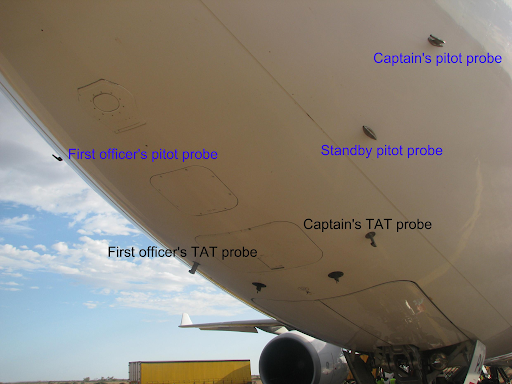
The accident involved temporary inconsistency in measured airspeeds associated with ice-crystal obstruction of the pitot probes, followed by autopilot disconnection and a sequence that ultimately developed into a stall.
Within seconds:
- The autopilot disconnected.
- Flight protections changed.
- Pilots suddenly had to fly manually in darkness, turbulence and confusing conditions.
Over the next few minutes, a series of control inputs led the aircraft into a high-altitude aerodynamic stall from which it never recovered.
The aircraft struck the Atlantic Ocean, killing everyone on board.
For nearly two years, investigators searched before recovering the flight recorders that finally revealed what had happened.
The investigation into Air France Flight 447 became one of the most important safety investigations of the modern aviation era.
Related Reading: How Airlines Respond to Missile Threat
✈️ SkypropreAir Insight
One blocked sensor did not bring down a modern airliner.
The catastrophe resulted from a complex chain involving unreliable airspeed information, automation changes, aircraft handling, crew coordination and difficulties recognising and recovering from a high-altitude stall.
Commercial aviation accidents almost never result from a single mistake.
Whether you’re crossing the Atlantic or travelling around the world, comparing fares before booking can save you hundreds of euros.
👉 Compare prices with Aviasales to find competitive fares before your next trip.
Why This Accident Changed Aviation Forever
Flight 447 exposed a reality that many outside aviation had never considered.
Modern aircraft are highly automated.
Automation makes flying safer.
But automation can also create situations where pilots suddenly have to take complete control with very little warning.
The accident prompted regulators worldwide to rethink how pilots should be trained when automation unexpectedly hands the aircraft back to humans.
One of the enduring lessons from Air France Flight 447 concerns unreliable airspeed at high altitude.
Today, pilots spend far more simulator time practising exactly these scenarios.
The Tiny Sensors That Changed Aircraft Design
Few passengers have ever heard of pitot tubes.
Yet these small probes are among the aircraft’s most important instruments.
They measure airspeed, providing critical information to both pilots and onboard computers.
Following Flight 447:
- Improved pitot tube designs were introduced.
- Inspection procedures became stricter.
- Airlines reviewed replacement schedules.
- Manufacturers enhanced system reliability.
For passengers, these changes are invisible.
But they quietly contribute to safer flights every day.
Related reading: The Most Dangerous Phase of Every Flight
Automation Is Brilliant—But Pilots Must Always Be Ready
One misconception after Flight 447 was that pilots had become “too dependent” on computers.
The reality is more nuanced.
Automation dramatically reduces workload and prevents many errors.
However, pilots must also be prepared for the rare moment when computers step aside.
That is exactly why modern airline training now places renewed emphasis on manual flying skills.
Pilots regularly practise situations they hope never to experience in real life.
Related reading: How Airbus Went from Underdog to Aviation Giant
✈️ SkypropreAir Insight
Airline pilots don’t simply learn to fly.
They repeatedly train to recover from situations that may occur only once in an entire career.
That’s one reason commercial aviation remains one of the safest forms of transportation.
How Pilot Training Changed Forever
Perhaps Flight 447’s greatest legacy isn’t found inside aircraft.
It’s found inside flight simulators.
Airlines across the world strengthened training in:
- High-altitude stall recovery
- Unreliable airspeed procedures
- Manual aircraft handling
- Crew communication
- Decision-making under pressure
- Recognising automation failures
Every new generation of airline pilots now benefits from lessons written in tragedy.
The legacy of Air France Flight 447 extends far beyond the Airbus A330.
Related Reading: The Hidden Science Behind Aircraft Oxygen Masks
What This Means for Passengers Today
Many travellers become anxious whenever they hear about aviation accidents.
Ironically, accidents often make future flying even safer.
Every major investigation produces:
- Better regulations
- Improved aircraft systems
- Enhanced pilot training
- Updated maintenance procedures
- Stronger international safety standards
Commercial aviation doesn’t ignore mistakes.
It studies them relentlessly.
For passengers, the story of Air France Flight 447 also demonstrates how aviation learns from catastrophe.
Could an Accident Like Air France Flight 447 Happen Today?
The answer is reassuring.
Modern aircraft include multiple layers of redundancy.
Critical systems have backups.
Pilots train continuously.
Aircraft manufacturers analyse millions of flight hours.
Airlines share safety data globally.
The circumstances that led to Flight 447 have been studied in extraordinary detail.
Today’s crews are significantly better prepared for similar situations.
That doesn’t mean aviation is risk-free.
It means the industry continuously learns and improves.
Unexpected delays, medical emergencies, or lost baggage can affect even the best-planned trips.
👉 Travel with confidence by protecting your journey with SafetyWing Travel Insurance.
✈️ SkypropreAir Verdict
Air France Flight 447 remains one of the most influential accidents in aviation history not because of how it ended, but because of what the industry learned afterward.
Its legacy is visible in pilot training, cockpit technology, aircraft design, and international safety regulations.
The tragedy claimed 228 lives. The lessons learned from it continue to influence the safety of commercial aviation today.
That is perhaps the most meaningful legacy any accident can leave behind.
Frequently Asked Questions
Could Air France Flight 447 happen again?
While no aviation risk can ever be completely eliminated, the industry has introduced significant improvements in pilot training, pitot tube design, cockpit procedures, and safety regulations that reduce the likelihood of a similar accident.
Why didn’t the pilots recover the aircraft?
Investigators concluded that unreliable airspeed indications, the sudden loss of automation, cockpit workload, and difficulties recognising a high-altitude stall combined to prevent a successful recovery.
Why is Air France Flight 447 still studied today?
Air France Flight 447 is regarded as one of the most important modern aviation accidents because it reshaped pilot training, aircraft design, automation philosophy, and international safety standards.