
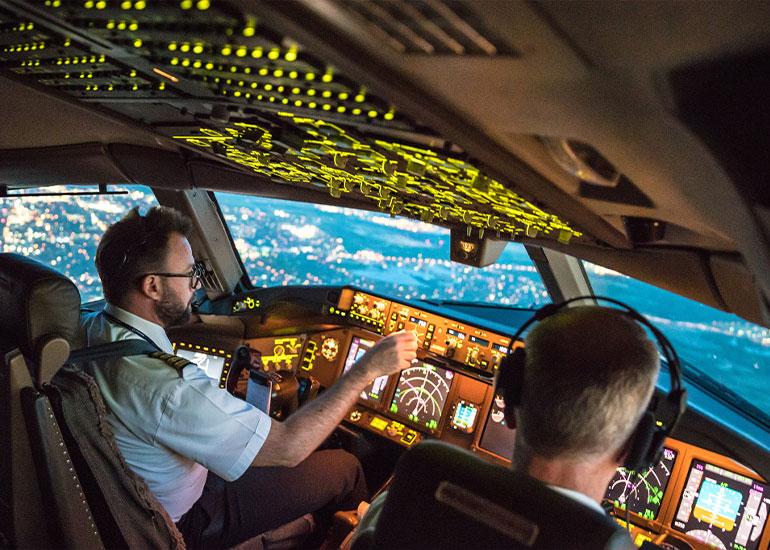
Both Pilots Fell Asleep at 36,000 Feet – How Could This Happen
Both Pilots Fell Asleep During Flight: How Could it Happen?
The Aircraft Was Flying. The Cockpit Was Silent.
High above Indonesia, an Airbus A320 was cruising toward Jakarta.
The aircraft was on autopilot.
Air traffic control called the flight.
No answer.
Controllers tried again.
Get the SkypropreAir Free Travel Pack
Plan smarter, choose a better seat and enjoy a more comfortable long-haul journey. Enter your details below to receive the Travel Pack.
Still nothing.
Other aircraft were reportedly asked to help establish contact.
Nothing.
Inside the cockpit, something extraordinary had happened:
both pilots were asleep.
Twenty-eight minutes after the last recorded transmission, the captain woke and realised the aircraft was no longer on the correct flight path.
He then discovered that the other pilot was asleep too.
The aircraft was brought back onto the correct route and eventually landed safely.
No passengers were injured.
But the incident raises a question that goes far beyond one flight:
How can two trained professional pilots end up asleep at the same time—and what prevents the same thing happening on another aircraft tomorrow?
What Actually Happened?
The incident involved Batik Air flight BTK6723, operated by an Airbus A320 on a domestic flight from Kendari to Jakarta on 25 January 2024.
According to Indonesia’s National Transportation Safety Committee, the pilots had already operated an earlier sector that morning.
During the return flight, the pilot-in-command received permission from the second-in-command to rest.
The second pilot remained responsible for the flight.
Later, the captain woke and asked whether his colleague wanted to rest.
He declined.
The captain resumed sleeping.
Then the unexpected happened.
The second pilot inadvertently fell asleep as well.
Air traffic control subsequently attempted repeatedly to contact the aircraft without receiving a response.
Approximately 28 minutes after the second pilot’s last recorded transmission, the captain woke.
He realised that the aircraft was not on the correct flight path, saw that his colleague was asleep and woke him.
Communication with ATC was restored and the flight continued to Jakarta, where it landed safely.
Related Reading: What Happens If Both Engines Fail?
How Can a Professional Pilot Simply Fall Asleep?
The answer is more complicated than simply being “tired.”
Fatigue affects human performance biologically.
A person can be highly trained, experienced and determined to remain awake—and still experience involuntary sleep when the body’s need for rest becomes strong enough.
One particularly dangerous phenomenon is a microsleep.
A microsleep may last only seconds.
The person’s eyes may close and awareness temporarily disappears.
The frightening part is that people don’t always recognise that it has happened.
In an environment where long periods of monitoring can be relatively quiet, fatigue can become particularly dangerous.
Fit to Fly Doesn’t Always Mean Well Rested
This distinction is crucial.
Pilots undergo aviation medical certification and airlines have procedures governing fitness for duty.
But medical fitness and fatigue are not the same thing.
A pilot may have no disqualifying medical condition and still have slept badly the previous night.
A medical examination can assess many aspects of health.
It cannot guarantee that someone obtained restorative sleep before every individual flight.
That means aviation safety partly depends on pilots recognising fatigue—and feeling able to report when they are not sufficiently rested to operate safely.
The Hidden Problem: Fatigue Isn’t Always Obvious
Alcohol can be measured.
Many illnesses have identifiable symptoms.
Fatigue is different.
Two people can sleep for the same number of hours and wake feeling completely different.
Sleep quality matters.
Circadian rhythm matters.
The time of day matters.
Previous workload matters.
Repeated early starts or overnight duties matter.
Personal circumstances can matter too.
In the Batik Air investigation, fatigue and rest circumstances became important parts of understanding how the event developed.
That illustrates why fatigue management cannot rely solely on asking:
“How many hours were you off duty?”
The better question is:
“Was that rest actually sufficient to restore alertness?”
Related Reading: Overnight vs Daytime Flights: Which Is Better?
Why Didn’t Autopilot Wake Them?
This is where passengers sometimes misunderstand what autopilot does.
Autopilot is extremely capable.
It can maintain altitude, heading and speed and follow programmed or commanded flight paths.
But autopilot is not a replacement pilot.
It does not assume the full responsibilities of the humans in the cockpit.
Pilots still need to communicate with air traffic control, monitor weather, verify navigation, manage systems, respond to changing clearances and deal with abnormalities.
In the Batik Air incident, the aircraft continuing to fly did not mean everything was normal.
The inability of ATC to contact the cockpit was itself a serious problem.
Why Didn’t Air Traffic Control Immediately Know They Were Asleep?
Controllers can see and monitor aircraft, but they cannot see inside the cockpit.
When an aircraft fails to answer a radio call, there are numerous possible explanations.
The crew may have changed to the wrong frequency.
There may be radio interference.
The transmission may have been blocked by another aircraft.
The crew may be temporarily occupied.
There could be equipment problems.
Controllers therefore try alternative methods of establishing contact, which can include repeated calls and asking another aircraft to relay a message.
A silent cockpit does not immediately tell ATC why communication has been lost.
Could the Aircraft Have Kept Flying on Autopilot?
Potentially for some time—but that isn’t reassuring enough.
An aircraft cruising normally with autopilot engaged may continue following its commanded parameters without constant physical control input.
But aviation is dynamic.
Weather changes.
ATC issues new instructions.
Traffic situations evolve.
Fuel must be monitored.
Systems must be supervised.
Eventually the aircraft must descend and land.
Autopilot reduces pilot workload.
It does not remove the need for alert pilots.
What Is Controlled Rest in the Cockpit?
This is another important distinction.
A pilot sleeping in the cockpit is not automatically evidence of something improper.
Some aviation authorities and operators permit carefully managed controlled rest during appropriate phases of flight under defined procedures.
The idea is straightforward.
A planned short rest can improve alertness later in a long duty period.
But controlled rest depends on one fundamental condition:
the other required pilot remains awake and capable of operating and monitoring the aircraft.
Two pilots unintentionally sleeping simultaneously is an entirely different safety situation.
How Aviation Manages Pilot Fatigue
Modern aviation does not rely on one defence.
Airlines use combinations of:
- flight and duty-time limitations
- mandatory rest periods
- fatigue-risk-management systems
- crew scheduling rules
- fitness-for-duty procedures
- fatigue reporting
- controlled-rest policies where permitted
- training and operational monitoring
The objective is not to pretend pilots never become tired.
Pilots are human.
The objective is to prevent ordinary human fatigue from developing into an unsafe operational situation.
That distinction is fundamental to modern aviation safety.
Could This Happen on a Long-Haul Flight?
Fatigue management becomes especially important during overnight and ultra-long-haul operations.
But long-haul aircraft can also have additional pilots specifically so crews can rotate through planned rest periods.
On some long flights, pilots use dedicated crew-rest facilities away from the flight deck.
That is very different from two pilots unexpectedly falling asleep.
A well-designed fatigue-management system recognises a simple reality:
humans need sleep, regardless of how sophisticated the aircraft becomes.
Related Reading: Long-Haul Comfort Master Guide (2026)
Should Passengers Be Worried?
Incidents involving both pilots being asleep are serious precisely because that is not how normal airline operations are supposed to function.
But the fact that an event becomes the subject of a formal safety investigation is also part of how aviation improves.
Investigators don’t simply ask:
“Who made the mistake?”
They ask:
“What combination of circumstances allowed the mistake to happen?”
Scheduling, rest, procedures, communication, training and organisational safeguards can all be examined.
The goal is to make recurrence less likely.
The Bigger Lesson Isn’t About Sleeping Pilots
The most interesting lesson from this incident isn’t that two pilots fell asleep.
It is that even in one of the world’s most technologically advanced transport systems, human biology still matters.
Aircraft can automatically control altitude.
They can navigate with extraordinary precision.
Computers can monitor thousands of parameters.
But none of those technologies eliminates the human need for sleep.
Perhaps the future of aviation safety therefore isn’t simply about making aircraft smarter.
It is also about designing systems that better recognise when the humans operating them are reaching their limits.
Because sometimes the greatest threat inside a sophisticated cockpit isn’t mechanical failure.
It’s an exhausted human being trying desperately to stay awake.
FAQs
Can airline pilots sleep during a flight?
On some operations, controlled rest or scheduled crew rest is permitted under specific rules and airline procedures. This is very different from both operating pilots unintentionally being asleep simultaneously.
Can autopilot fly if the pilots are asleep?
Autopilot can maintain commanded flight parameters and follow programmed guidance, but it does not replace alert pilots. Human crews remain responsible for monitoring systems, communicating with ATC and responding to changing conditions.
What happens when pilots become too fatigued to fly?
Pilots are expected to comply with fitness-for-duty requirements and applicable fatigue procedures. Airlines also use duty-time limits, rest requirements and fatigue-risk-management measures designed to reduce fatigue-related risk.
SkypropreAir Verdict
The Batik Air incident provides a powerful reminder that aviation safety isn’t built on the assumption that pilots are superhuman.
It is built on the opposite assumption:
pilots are human, humans become tired, and the system must be designed around that reality.
Technology can keep an aircraft flying.
But technology cannot make an exhausted pilot well rested.
And that leaves aviation with an important question:
As aircraft become increasingly automated, should the next great safety innovation focus less on the machine and more on monitoring the human being sitting in front of it?