
Airline Seat Pitch: WestJet’s 28-Inch Seat Experiment Raises Bigger Question for Economy Passengers
How Tight Is Too Tight? WestJet’s 28-Inch Seat Experiment Raises a Bigger Question for Economy Passengers
For years, economy passengers have watched something quietly disappear from aircraft cabins.
Not the free meals.
Not checked baggage.
Not even the smiles at the boarding gate.
Space.
Get the SkypropreAir Free Travel Pack
Plan smarter, choose a better seat and enjoy a more comfortable long-haul journey. Enter your details below to receive the Travel Pack.
An inch here. Another inch there. Another row squeezed into the aircraft.
Most passengers probably couldn’t tell you the seat pitch of the aircraft they’re about to board. But after three, six or ten hours sitting in it, their knees certainly can.
And WestJet’s recent decision to remove its controversial 28-inch-pitch economy configuration from affected Boeing 737 aircraft raises an uncomfortable question for the entire airline industry:
Airline seat pitch may look like a small number on a seat map, but the difference between 28 and 33 inches can completely change an economy-class journey.
How tight is too tight for economy class?
WestJet Tried 28 Inches And Has Now Stepped Back
WestJet had introduced a higher-density Boeing 737 configuration that included economy seats with just 28 inches of pitch.
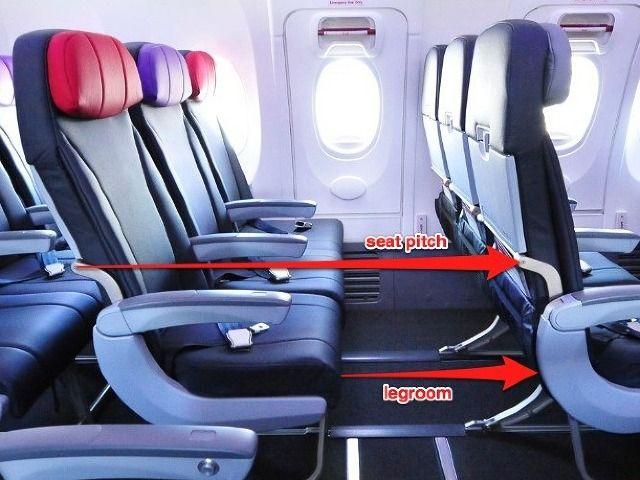
Seat pitch isn’t exactly the same thing as legroom. It measures the distance from a point on one seat to the same point on the seat in front.
But for passengers, the practical consequence is obvious.
Less pitch generally means less personal space.
WestJet has now completed the removal of the controversial 28-inch configuration from the affected aircraft, reducing the cabin from 180 seats to 174.
Six seats may not sound significant.
Spread those six seats across an aircraft cabin, however and suddenly there is room to give passengers something airlines have spent decades gradually taking away:
space.
Airline Seat Pitch: What Does 28 Inches Actually Feel Like?
Numbers such as 28, 30 and 32 inches don’t mean much when you’re looking at a booking screen.
This is why choosing the best seats on a plane can make a surprisingly large difference, particularly on longer journeys.
Inside an aircraft, the difference can be substantial.
At approximately 28 inches, taller passengers may find their knees extremely close to the seat ahead.
At around 30 inches, the experience remains compact but can become noticeably more manageable.
At 31–32 inches, many passengers begin to feel they have reasonable economy-class space.
And once you approach 33 inches, economy can feel surprisingly different.
You can compare these differences more closely in our Seat Comparison Database, which looks at how aircraft and seating configurations affect passenger comfort.
Of course, seat design matters too. Modern slimline seats can sometimes create additional usable knee space even when the published pitch hasn’t changed dramatically.
But there is a limit to what clever engineering can achieve.
You cannot redesign the human body.
Now Consider the Opposite Strategy
WestJet’s decision becomes even more interesting when compared with what another airline has been doing.
Air Premia has been reducing the number of seats aboard some of its Boeing 787-9 aircraft as it works toward providing at least 33 inches of pitch in economy.
If you’re flying on this aircraft, our Boeing 787 Dreamliner seat guide explains which seats and rows can offer the better economy experience.
Think about the difference in philosophy.
One approach asks:
How many passengers can we fit into this aircraft?
The other asks:
How much space should each passenger reasonably have?
Those two questions can produce very different cabins.
And passengers are increasingly learning to recognise the difference.
The Economics Are Easy to Understand
Airlines don’t reduce legroom simply because they want passengers to be uncomfortable.
Aircraft are extraordinarily expensive assets.
Every flight has enormous costs: fuel, crew, airport charges, maintenance, leasing or financing, catering, insurance and countless other expenses.
Adding another row of seats potentially creates additional revenue on thousands of flights throughout an aircraft’s operating life.
Multiply six extra seats by hundreds of flights.
Then multiply that across an entire fleet.
Suddenly, a few inches of cabin space become worth millions.
From an airline accountant’s perspective, the attraction is obvious.
From seat 27B, however, the calculation looks rather different.
Economy Passengers Are Not Cargo
There is an uncomfortable tendency in modern aviation to discuss passengers almost entirely through efficiency metrics.
Load factor.
Revenue per available seat kilometre.
Ancillary revenue.
Cabin density.
Yield.
All are legitimate business measurements.
But somewhere inside those calculations is a human being who may spend eight, ten or fourteen hours sitting in that seat.
That passenger needs to eat.
Sleep.
Move.
Use a laptop.
Get up to visit the toilet.
And occasionally move their knees.
Efficiency matters.
But passenger dignity should matter too.
Should There Be a Minimum Economy Seat Pitch?
This is where the debate becomes much more interesting.
Should airlines simply be allowed to determine how closely seats are positioned?
Or should aviation regulators eventually establish minimum passenger-space standards?
There are arguments on both sides.
Airlines would reasonably argue that aircraft configurations vary enormously and that regulation could increase costs and ultimately increase ticket prices.
Passengers might respond with a simpler question:
At what point does an airline seat become unreasonably restrictive?
Twenty-eight inches?
Twenty-seven?
Twenty-six?
Without some practical lower boundary, the economic incentive will always exist to experiment with squeezing another row into the cabin.
The Cheapest Ticket Isn’t Always the Cheapest Journey
This is also why passengers should stop comparing flights purely by ticket price.
Knowing how to choose the right airline means looking beyond the fare and comparing seat space, aircraft type and overall onboard comfort.
Imagine two airlines operating the same route.
Airline A costs €30 less but provides a tight 28–29-inch economy seat.
Airline B costs slightly more but offers 32–33 inches.
For a 90-minute flight, you might happily take the cheaper option.
For a ten-hour overnight flight?
That extra €30 could be one of the best travel purchases you make.
This is why checking the aircraft type, seat configuration and expected seat pitch before booking can sometimes matter almost as much as comparing fares.
Our guide to the best aircraft for long-haul economy flights compares the aircraft that generally offer passengers the most comfortable economy experience.
One Inch Sounds Tiny — Until You’re Sitting There for Ten Hours
This is perhaps the strangest thing about airline seating.
We are talking about inches.
Tiny measurements.
Yet those inches can completely change how a journey feels.
An extra inch may mean your knees no longer touch the seat ahead.
Two inches may give you enough room to reposition your legs.
Three inches can make the difference between constantly watching the clock and arriving feeling reasonably human.
Passengers don’t necessarily need luxury.
Most economy travellers understand what they purchased.
What they increasingly want is something much simpler:
a fair amount of space for the journey they paid for.
WestJet’s Decision Could Carry a Bigger Message
WestJet removing its 28-inch configuration doesn’t mean cramped economy cabins are disappearing.
Far from it.
But it demonstrates something important.
There may eventually be a point where adding more seats stops creating value and starts damaging the passenger experience enough that airlines have to reconsider.
Perhaps the future competition in economy class won’t only be about price.
For passengers planning longer journeys, our Long-Haul Comfort Master Guide brings together our advice on aircraft, airlines, seats and strategies for making economy travel more comfortable.
Perhaps airlines will increasingly compete on something much more basic:
Who gives passengers their space back?
And if that happens, economy travellers may discover that one of the most valuable features on their next flight isn’t a better meal, faster Wi-Fi or another movie.
It could simply be two more inches between their knees and the seat in front.
Frequently Asked Questions
What is airline seat pitch?
Seat pitch is the distance between a point on one aircraft seat and the same point on the seat immediately in front or behind it. It is commonly used as an indication of the amount of space available around an economy seat.
Is 28-inch seat pitch uncomfortable?
It can be particularly restrictive for taller passengers, although comfort also depends on seat design, passenger height and body proportions. On longer flights, small differences in pitch can become much more noticeable.
Is 32-inch seat pitch good for economy class?
Around 31–32 inches can provide a noticeably more comfortable economy experience than very high-density 28–29-inch configurations. A 33-inch pitch can be particularly attractive for passengers prioritising legroom.
The Question Airlines Should Be Asking
Airlines have become extraordinarily good at calculating how many seats can physically fit inside an aircraft.
Perhaps the next question should be:
How many seats should fit inside it?
And for passengers, the question is even simpler:
What is the smallest seat pitch you would accept for a long-haul flight — 32 inches, 30 inches, 28 inches… or does ticket price ultimately decide?