
Best Seats on the Boeing 787 Dreamliner: Which Rows Should You Choose?
You booked a Boeing 787 Dreamliner.
Good choice.
But there’s one decision that could make a surprisingly big difference to the next eight, ten or fourteen hours:
Which seat should you choose?
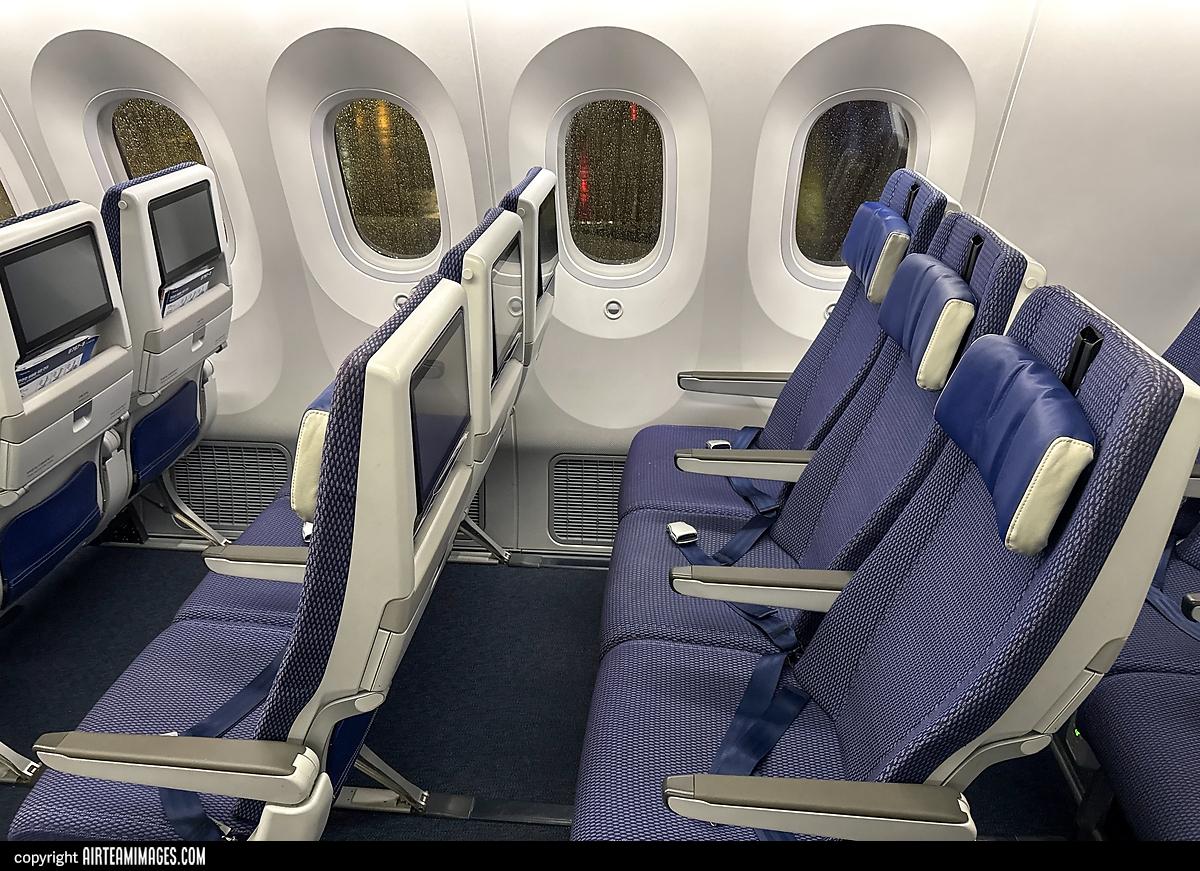
The Boeing 787 is one of the world’s most advanced long-haul aircraft, with large windows, modern cabin lighting and a passenger-focused cabin environment.
Get the SkypropreAir Free Travel Pack
Plan smarter, choose a better seat and enjoy a more comfortable long-haul journey. Enter your details below to receive the Travel Pack.
But don’t make the mistake of assuming every seat on a Dreamliner is equally comfortable.
It isn’t.
A good 787 seat can give you extra space, less disturbance and a considerably more comfortable long-haul journey.
Choose badly, and you could spend the flight beside a lavatory queue, near a busy galley or trapped in the middle of a 3-3-3 row.
Here’s how to find the best seats on a Boeing 787 before you fly.
Flying on a Boeing 787? Before choosing your seat, see our complete Best Seats on a Plane guide to compare window, aisle, bulkhead and extra-legroom options.
Best Seats on Boeing 787: Quick Answer
For most Economy passengers, the best choices are generally:
| What You Want | Where to Look |
|---|---|
| Extra legroom | Exit-row or extra-legroom seats |
| Quieter journey | Forward Economy, away from galleys/lavatories |
| Easy aisle access | Aisle seat |
| Best for sleeping | Window seat away from toilets and galleys |
| Travelling as a couple | Window + aisle if you’re comfortable with the risk of someone taking the middle |
| Fastest exit after landing | Forward Economy |
| Best outside view | Window seat positioned away from the wing |
| Seats to approach carefully | Last rows, lavatory/galley areas and some bulkhead seats |
But there’s an important catch.
There is no single “best row” across every Boeing 787.
Airlines decide their own cabin layouts, seat pitch, premium sections, lavatory locations and row numbering.
So always check the exact airline and aircraft configuration before paying for a particular seat.
First: Which Boeing 787 Are You Flying?
Finding the best seats on the Boeing 787 begins with identifying whether you will be flying on the 787-8, 787-9 or 787-10, followed by checking the airline’s exact seat map.
There are three main Dreamliner variants:
According to Boeing, the Dreamliner family includes the 787-8, 787-9 and 787-10.
Want to compare aircraft before choosing your seat? Use the SkypropreAir Seat Comparison Database to compare layouts and passenger comfort across popular long-haul aircraft.
Boeing 787-8
The shortest member of the family.
Because airlines configure their aircraft differently, the size and location of the Economy cabin can vary considerably.
Boeing 787-9
The longer 787-9 is widely used on long-haul routes and can accommodate more passengers than the 787-8.
Again, airlines can divide the cabin differently between Business, Premium Economy and Economy.
Boeing 787-10
The 787-10 is the longest Dreamliner.
Its larger cabin means there may be substantially more Economy rows depending on the airline’s configuration.
The important lesson?
Don’t choose a seat simply because someone online says “Row 27 is the best seat on a Dreamliner.”
Row 27 on one airline could be completely different from Row 27 on another.
Why the 3-3-3 Layout Matters
A common Boeing 787 Economy arrangement is:
ABC – DEF – JKL
That’s three seats beside one window, three in the centre and three beside the opposite window.
This creates one obvious disadvantage:
middle seats.
If you’re travelling alone, seats B, E and K will generally be less attractive than the window and aisle seats around them because these are the middle seats in a typical 3-3-3 configuration.
For many passengers, therefore, choosing the right seat position can matter as much as choosing the right row.
1. Forward Economy — My Best All-Round Choice
If I had to choose a standard Economy seat without paying heavily for an upgrade, I’d start by looking toward the front of the Economy cabin.
Why?
Forward Economy can offer several practical advantages:
- quicker exit after landing
- potentially less foot traffic than areas around rear lavatories
- easier access to the front of the cabin
- often a calmer feeling than the busiest rear sections
It doesn’t automatically mean more legroom.
But for the combination of convenience, reduced disturbance and faster disembarkation, forward Economy is one of the first areas I’d examine.
2. Exit-Row Seats — Best for Legroom
For taller passengers, the most attractive Economy seats may be those offering additional legroom around an exit.
The ability to stretch your legs can transform a long-haul flight.
But extra space comes with trade-offs.
Depending on the aircraft configuration, an exit-area seat can have:
- restrictions on storing baggage during take-off and landing
- fixed armrests
- increased passenger movement
- proximity to doors or lavatories
- eligibility requirements for passengers seated there
So don’t buy an exit-row seat based solely on the words “extra legroom.”
Look at what surrounds it first.
3. Window Seats — Best for Sleeping
If your priority is sleeping, I generally favour a window seat.
You can lean toward the cabin wall and, crucially, nobody needs you to stand up when they want to visit the lavatory.
The 787 is particularly attractive for passengers who enjoy looking outside because of its distinctive large electronically dimmable windows.
However, check the window alignment.
Not every seat necessarily gives you the perfectly positioned window you might expect.
For an overnight flight, my ideal combination would be:
window + forward/mid Economy + away from lavatories and galleys.
4. Aisle Seats — Best for Passengers Who Like Freedom
The aisle may be better if you:
- visit the lavatory frequently
- like walking around during long flights
- don’t want to ask other passengers to move
- feel uncomfortable being enclosed beside the window
The trade-off is interruption.
People may brush past you, cabin crew use the aisle throughout the flight, and your seatmates may need you to move.
So there isn’t a universal winner in the window-versus-aisle debate.
Choose according to how you actually travel.
5. Bulkhead Seats — Better Than They Look?
Bulkhead seats can be excellent, but they require careful inspection.
Depending on the airline, they may offer a feeling of additional space because there isn’t a conventional seat immediately in front of you.
But potential disadvantages can include:
- fixed armrests
- tray tables stored in the armrest
- no under-seat storage during certain phases of flight
- proximity to bassinets
- proximity to galleys or lavatories
A bulkhead is therefore not automatically a premium Economy experience hiding inside Economy.
Check the exact seat map first.
Seats I Would Think Twice About on a Boeing 787
Sometimes avoiding a bad seat matters more than finding the theoretically perfect one.
Seats immediately beside lavatories
Expect doors opening, queues forming and passengers standing nearby.
Seats beside galleys
Meal preparation, cabin-crew activity and lighting can make these areas less attractive for passengers trying to sleep.
The very last rows
Depending on the configuration, these can experience more passenger traffic and may be close to lavatories or galleys.
Some aircraft configurations may also have limitations around seat recline in particular rows.
Middle seats
On a long overnight journey, spending ten hours between two strangers isn’t my first choice.
Unless the price difference is substantial, I’d normally choose a window or aisle.
Best Boeing 787 Seat for Different Travellers
Tall passenger
Start with extra-legroom or exit-row options, but inspect the surrounding facilities before paying.
Nervous flyer
Consider a seat around the wing area, where aircraft movement may feel less pronounced than toward the extremities of the cabin.
Light sleeper
Choose a window seat away from lavatories and galleys.
Passenger with a short connection
Choose forward Economy where possible to improve your chances of leaving the aircraft quickly.
Passenger who gets up frequently
Choose the aisle.
Couple
Look carefully at the airline’s exact layout and decide whether easy aisle access or sitting together matters most.
787-8 vs 787-9 vs 787-10: Does the Best Seat Change?
Yes — but mostly because the airline configuration changes, rather than because one Dreamliner variant magically has better Economy seats.
The 787-8, 787-9 and 787-10 differ in length and passenger capacity.
Airlines then make another layer of decisions:
- how many cabins to install
- how many Economy rows to use
- where Premium Economy begins and ends
- where lavatories are located
- which rows receive extra legroom
- seat pitch
- seat design
- row numbering
That’s why SkypropreAir recommends choosing seats using the exact airline seat map, not aircraft type alone.
The best seats on Boeing 787 aircraft therefore depend heavily on the airline’s individual configuration.
Still deciding which aircraft to book? See our Best Seats by Aircraft Type comparison, where we compare the Boeing 787 with the Airbus A350, Boeing 777 and Airbus A330.
The 60-Second Boeing 787 Seat Check
Before paying for seat selection, ask yourself five questions:
1. Am I looking at the correct 787 variant?
787-8, 787-9 or 787-10?
2. Am I looking at my airline’s exact configuration?
Aircraft type alone isn’t enough.
3. What’s directly in front of and behind my seat?
Look for lavatories, galleys, bulkheads and exits.
4. What matters most to me?
Legroom? Sleep? Aisle access? Fast disembarkation?
5. Am I paying for a genuinely better seat — or simply a different seat?
That’s the question airlines would probably prefer passengers didn’t ask often enough.
✈️ Choosing your Boeing 787 flight?
Compare flight options, aircraft and fares before booking. A slightly different flight could give you a much better seat choice for a long-haul journey.
SkypropreAir Verdict: Where Would I Sit?
When choosing the best seats on Boeing 787 aircraft, I wouldn’t focus on row number alone. For an ordinary long-haul Economy journey, my first search would be forward Economy…
Forward Economy + window or aisle + away from lavatories and galleys.
If legroom were my biggest priority, I’d investigate the airline’s extra-legroom and exit-row options.
For an overnight flight, I’d lean toward a window.
For a daytime journey where I expected to move around frequently, I’d choose an aisle.
And unless the fare difference made it worthwhile, I’d avoid spending ten hours in a middle seat.
The real secret isn’t finding one magical Boeing 787 seat.
It’s understanding what makes a seat good for you.
Before You Choose Your Seat
Don’t stop with the 787.
Compare the Best Seats on a Plane to understand how exit rows, bulkheads, window seats, aisle seats and cabin position compare across different aircraft.
Then use the SkypropreAir Seat Comparison Database to compare aircraft before booking your next long-haul flight.
Booking a flight? Compare your flight options before choosing the aircraft and seat — because the cheapest ticket isn’t always the most comfortable journey.
✈️ Ready to choose your seat?
Don’t rely on the seat number alone. Compare window, aisle, bulkhead, exit-row and cabin-position options in our Best Seats on a Plane guide before making your final choice.
Frequently Asked Questions
What are the best seats on a Boeing 787?
For many Economy passengers, forward-cabin window or aisle seats away from lavatories and galleys provide a good balance. Extra-legroom and exit-row seats may be better for taller passengers, depending on the airline’s configuration.
Is a window or aisle seat better on the Boeing 787?
A window is generally better for sleeping and uninterrupted rest, while an aisle provides easier access to the cabin and lavatories. The better choice depends on your priorities.
Are Boeing 787 exit-row seats worth paying for?
They can be, particularly for taller passengers who value legroom. However, check the exact seat map because some exit-area seats may be close to lavatories, doors or high-traffic areas.
One Final Question
If you had to spend 12 hours on a Boeing 787, which would you choose:
extra legroom beside a busy lavatory — or a standard window seat in a quiet part of the cabin?
Sometimes the “best” seat isn’t the one with the most space.
It’s the one with the fewest compromises.