
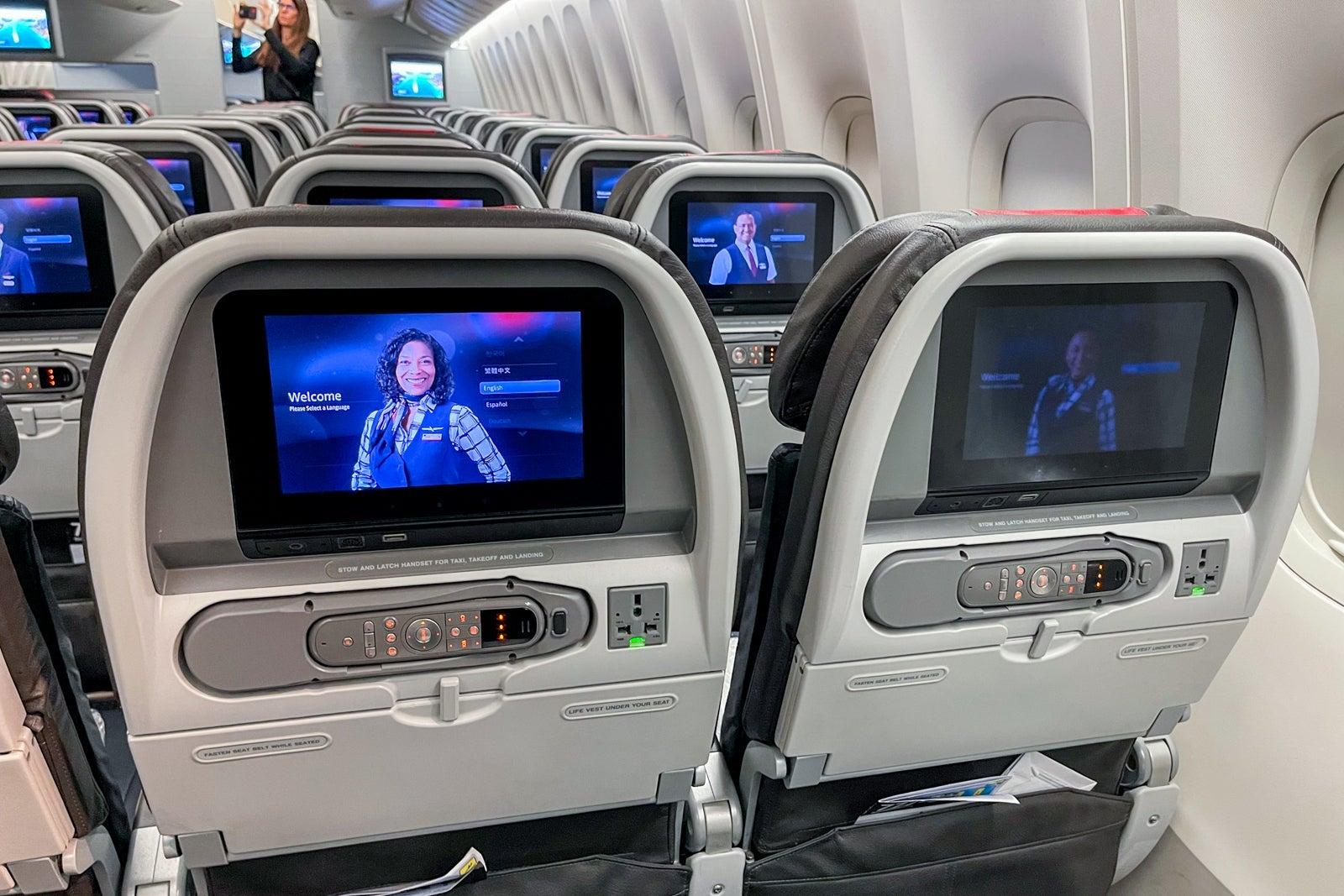
SeatBack Entertainment Screens: Are They Making a Comeback?
Are Airlines Finally Realising Economy Passengers Still Want Seatback Entertainment Screens?
For years, airline passengers were being told that the screen in their pocket was the future.
Why install expensive entertainment systems into every aircraft seat when almost every passenger already carries a smartphone, tablet or laptop?
Some airlines began moving away from seatback entertainment altogether.
Then something interesting happened.
The seatback screen started coming back.
Get the SkypropreAir Free Travel Pack
Plan smarter, choose a better seat and enjoy a more comfortable long-haul journey. Enter your details below to receive the Travel Pack.
On August 18, 2026, American Airlines announced a major overhaul of its narrowbody fleet that will eventually put entertainment screens at every seat, alongside high-speed Wi-Fi and an expanded premium cabin.
At first glance, this looks like another airline product announcement.
But it may represent something much bigger.
Airlines could be rediscovering something passengers have known all along: your own device is not always a substitute for a properly equipped aircraft seat.
Before booking, passengers can also compare Economy seats across different aircraft using the SkypropreAir Seat Comparison Database.
And on a five-, six- or seven-hour flight, that difference can matter far more than airlines sometimes acknowledge.
The Great Seatback Screen Debate
The argument for removing seatback screens once seemed convincing.
Passengers increasingly travel with smartphones.
Tablets have become commonplace.
Streaming services allow travellers to download films before departure.
Removing screens can also reduce aircraft weight and eliminate equipment that needs maintenance.
So why should an airline install thousands of screens?
Because the passenger experience is more complicated than that.
Imagine boarding a six-hour flight with 18% battery remaining on your phone.
You want to preserve enough power to contact someone when you land.
Your charging port isn’t working properly.
Or perhaps you simply don’t want to hold your phone or balance a tablet for hours.
Suddenly, that screen built into the seat in front of you becomes remarkably valuable.
Your Phone and a Seatback Screen Don’t Do the Same Job
There is another important difference.
Your phone is a personal communication device.
You use it for messages, photographs, banking, boarding passes, maps and countless other tasks.
Using it continuously for entertainment during a long flight consumes battery life and ties up the device.
A seatback entertainment system doesn’t.
You sit down.
Put on your headphones.
Choose a film.
And your phone remains available when you need it.
That sounds like a small distinction.
On a long journey, it isn’t.
Seatback Entertainment Can Make Economy Feel Better
Economy Comfort is normally discussed in inches – particularly seat pitch, width and recline.
Those things unquestionably matter.
But comfort is also psychological.
A passenger who is absorbed in a film for two hours may perceive a long journey very differently from someone repeatedly checking the remaining flight time.
Entertainment doesn’t make a 30-inch seat pitch larger.
But it can make six hours in that seat feel shorter.
That makes inflight entertainment part of the overall passenger-comfort equation.
There Is Another Advantage Passengers Rarely Consider
Seatback screens can provide something beyond movies.
Modern systems may display the aircraft’s location, altitude, remaining flight time and connecting information.
For aviation enthusiasts, the moving map can become entertainment in itself.
For nervous flyers, knowing where the aircraft is and how much of the journey remains may also provide reassurance.
And unlike a personal device, the information remains directly in the passenger’s line of sight.
But Seatback Screens Have Their Problems
They are not automatically better.
A broken screen directly in front of you can be incredibly frustrating.
Touchscreens can sometimes require passengers to repeatedly press the back of the seat ahead.
Older systems can be slow.
Equipment boxes associated with some entertainment systems may also reduce usable space around a passenger’s feet.
And every additional component installed aboard an aircraft adds weight and maintenance requirements.
So airlines face a genuine trade-off.
Wi-Fi May Ultimately Matter Even More
There is another possibility.
Perhaps the future isn’t:
seatback screen OR personal device.
It is both.
High-speed satellite internet is rapidly changing what passengers expect onboard.
A traveller could watch the aircraft’s entertainment system while simultaneously messaging family, checking email or browsing the internet on a personal device.
That combination creates something much closer to the digital environment passengers experience on the ground.
And this may explain why the modern aircraft cabin is evolving again.
The screen isn’t necessarily replacing the smartphone.
It is complementing it.
The Bigger Battle Is Over Passenger Experience
American Airlines’ decision also reveals something about airline competition.
Airlines increasingly compete not simply on destinations and ticket prices but on the quality of the journey itself.
Passengers compare:
- seat pitch
- Wi-Fi
- entertainment
- power outlets
- cabin layouts
- aircraft types
- premium cabin options
Want to see how aircraft compare? Check the SkypropreAir Seat Comparison Database before choosing your next Economy seat.
That is particularly important on longer flights where small differences become increasingly noticeable.
A one-hour journey without entertainment may barely matter.
Six hours is different.
What Should You Look For Before Booking?
Don’t assume two flights operated by the same airline provide exactly the same onboard experience.
Aircraft configurations can vary.
Before booking a longer flight, check:
Aircraft type: A widebody and narrowbody can provide very different experiences. See our guide to the best aircraft for long-haul Economy flights for a broader comparison.
Seat layout: A 2-4-2 configuration may appeal to couples, while 3-3-3 configurations create more middle seats.
Seat pitch: Even aircraft of the same type can have different seating densities.
Entertainment: Check whether the aircraft provides seatback screens or streaming entertainment.
Power: USB and electrical outlets become increasingly important on longer flights.
Wi-Fi: Availability, speed and pricing can vary significantly.
Choosing the right flight isn’t only about finding the cheapest fare.
It is about understanding what you will actually experience after you sit down.
The Seatback Screen May Not Be Dead After All
For several years, personal devices appeared capable of making built-in entertainment obsolete.
Instead, the opposite may be happening.
Passengers now travel with more technology than ever, yet airlines are discovering that a well-equipped seat can still be a competitive advantage.
The best future aircraft cabins may therefore offer passengers both options:
a high-quality entertainment screen in front of them and fast internet connecting the device in their hand.
Because when passengers spend several hours confined to an Economy seat, comfort isn’t determined by one measurement alone.
Seat width matters.
Legroom matters.
Cabin noise matters.
Aircraft type matters.
And sometimes, having a good film directly in front of you matters too.
The SkypropreAir Verdict
Seatback entertainment isn’t essential on every flight.
But once journeys become longer, it becomes a meaningful part of the passenger experience.
If two similarly priced flights offer comparable schedules and seat comfort, but one provides modern seatback entertainment, reliable power and fast Wi-Fi, that aircraft has a genuine comfort advantage.
The lesson for passengers is simple:
Don’t just compare the ticket price. Compare the seat—and everything surrounding it.
Before you book: Use the SkypropreAir Seat Comparison Database to compare seat pitch, layouts and Economy comfort across popular aircraft.
FAQs
Are seatback screens better than using your own device?
For longer flights, they can be. They preserve your device’s battery, provide a convenient viewing position and often include flight information and moving maps.
Do all aircraft operated by the same airline have the same entertainment system?
No. Cabin equipment can vary significantly between aircraft types and even between different aircraft within the same fleet.
Should inflight entertainment influence which flight I book?
For short flights, probably not significantly. For longer journeys, however, entertainment, Wi-Fi, charging facilities and seat comfort together can meaningfully affect the overall experience.