
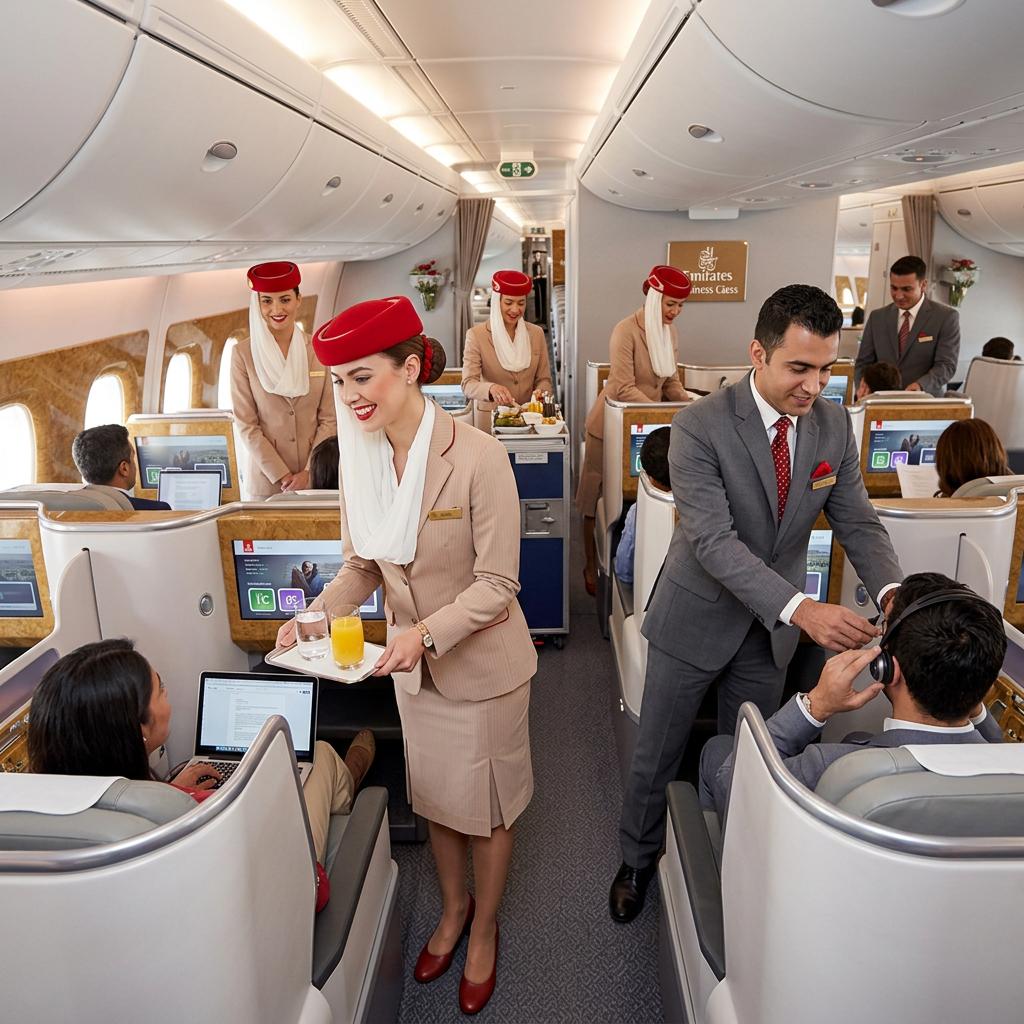
She Paid for Emirates Business Class — So Why Did She Say She Felt Invisible?
She Paid for Emirates Business Class — So Why Did She Say She Felt Invisible?
She Paid for Premium Treatment. She Says She Felt Invisible.
This Emirates Business Class complaint raises a difficult question: when passengers pay thousands for premium service, how consistent should that service be?
Business Class is supposed to make you feel looked after.
Priority service. Lounge access. Better meals. More personal attention. A seat costing considerably more than the one behind the curtain.
But one Emirates passenger says her experience left her feeling something very different:
overlooked.
Get the SkypropreAir Free Travel Pack
Plan smarter, choose a better seat and enjoy a more comfortable long-haul journey. Enter your details below to receive the Travel Pack.
Indian entrepreneur Rachana Ramchand has alleged that she was repeatedly overlooked during an Emirates Business Class journey, including during parts of the lounge and onboard experience, while another passenger nearby received service.
The Emirates Business Class complaint went viral, attracting widespread attention and triggering a much larger debate about airline hospitality, unequal treatment and perceived bias.
Some people supported her interpretation and argued that passengers should receive equal attention regardless of their background or appearance.
Others questioned whether the incidents demonstrated discrimination at all, suggesting they could have resulted from service inconsistencies or misunderstandings.
That distinction matters.
SkypropreAir cannot independently determine from a viral account whether discrimination occurred, and an allegation should not be presented as an established fact.
But the controversy raises a question worth examining long after this particular story disappears from social media:
Can passengers sometimes be treated differently without anyone consciously deciding to treat them differently?
What This Emirates Business Class Complaint Reveals About Poor Service
Everyone can be accidentally overlooked.
A flight attendant may be dealing with another passenger.
A lounge employee may simply miss someone.
A meal request can be forgotten.
One isolated incident may be nothing more than human error.
But imagine being overlooked repeatedly while watching someone sitting beside you receive attention.
At what point does poor service stop feeling accidental?
That is where perception becomes extremely important.
The passenger sees the interaction from one perspective.
The employee may see it completely differently.
Neither perspective automatically proves why something happened.
But for an airline, the passenger’s experience still matters.
If someone leaves a premium cabin genuinely believing they were treated differently, that is something worth examining rather than dismissing.
The Difficult Question: Can Unconscious Bias Affect Airline Service?
Discrimination does not always arrive wearing a name badge.
Human beings make thousands of rapid judgements every day, often without consciously recognising them.
In hospitality, those judgements can influence whom we notice first, how warmly we speak to someone, how quickly we respond or what assumptions we make about a customer.
That does not mean every service mistake is discrimination.
Nor does it mean an employee who overlooks a passenger is necessarily prejudiced.
But it does explain why airlines and other hospitality businesses train employees around cultural awareness, professionalism and consistent customer treatment.
The objective should not simply be:
“Don’t discriminate.”
It should also be:
“Make the standard of service consistent enough that passengers don’t have reason to wonder whether they were treated differently.”
A €4,000 Seat Doesn’t Make Someone More Important
There is another uncomfortable dimension to this debate.
Business Class passengers pay considerably more than Economy passengers.
That buys additional services.
It may buy lounge access, priority boarding, a lie-flat seat, upgraded meals, additional baggage and more personalised cabin service.
But it does not buy greater human worth.
Someone sitting in seat 2A deserves no more basic dignity than someone sitting in 52K.
The commercial distinction is different.
If an airline sells a passenger a premium package containing enhanced service, that passenger can reasonably expect the advertised service to be delivered.
Premium fares should buy premium services—not premium humanity.
Respect should be cabin-wide.
Related Reading: Most Comfortable long-haul Airlines 2026
What About Being Asked to Lower Your Voice?
Another part of the reported incident involved Ramchand and another passenger allegedly being asked to lower their voices while talking.
Taken in isolation, such a request would not necessarily be unusual.
Cabin crew regularly have to balance conflicting passenger needs.
One passenger wants to talk.
Another wants to sleep.
Someone wants their reading light on.
The person beside them wants darkness.
This becomes particularly delicate on overnight long-haul flights.
The issue is therefore not simply whether cabin crew ask someone to speak more quietly.
How the request is communicated matters.
A courteous explanation can resolve the situation immediately.
A poorly handled interaction, particularly after a passenger already feels overlooked, can reinforce the perception that they are being singled out.
Context changes how people interpret service.
Related Reading: Premium Economy: Is it worth the Upgrade?
Business Class Is More Than a Lie-Flat Seat
Airlines have spent billions improving premium cabins.
Privacy doors.
Huge entertainment screens.
Designer amenity kits.
Airport lounges that resemble luxury hotels.
Restaurant-style dining.
Seats that transform into beds.
But there’s something airlines cannot engineer into an aircraft:
how a passenger feels after interacting with another human being.
A spectacular Business Class seat cannot completely compensate for service that makes a passenger feel unwelcome.
This is why service consistency may be one of the most valuable and hardest to replicate.
Hardware can be standardised.
Human interaction cannot.
Social Media Has Changed the Balance of Power
Twenty years ago, a passenger unhappy with an airline might have written a letter.
Perhaps they would tell friends and family.
The airline largely controlled how far the complaint travelled.
That world has disappeared.
Today, a passenger can leave an aircraft, open a phone and describe their experience to hundreds of thousands or millions of people.
A customer-service failure can become an international reputational problem before an airline has completed an internal investigation.
That gives passengers unprecedented power.
But it also creates responsibility.
A viral accusation can seriously affect individuals and companies, which is why allegations and established facts should remain clearly separated.
Airlines, meanwhile, face a difficult balancing act.
Ignore a viral complaint and they may appear indifferent.
React before establishing what happened and they risk reaching conclusions without sufficient evidence.
Acknowledgement followed by a fair investigation is usually more valuable than either instant dismissal or instant judgement.
What Should You Do If You Believe You’re Being Treated Differently?
Start with something surprisingly powerful:
Ask.
If passengers around you have received meal service and you haven’t, politely bring it to the crew’s attention.
There may be a straightforward explanation, and giving the airline an opportunity to correct the problem can resolve many situations immediately.
If the pattern continues and you remain concerned, document specifics.
Note the flight number, date, approximate time, cabin and what happened.
Specific information is far more useful than simply writing:
“The crew discriminated against me.”
For example:
“Passengers immediately around me were offered drinks during service, but I was not approached. I raised the issue approximately 20 minutes later.”
That gives the airline something concrete to investigate.
If you believe discrimination occurred, explain why you reached that conclusion while distinguishing what you personally observed from what you inferred.
That strengthens rather than weakens a legitimate complaint.
Should This Change How You Choose an Airline?
Probably not on the basis of one viral account alone.
Airlines operate thousands of flights involving enormous numbers of passenger interactions.
One incident—whether ultimately substantiated, misunderstood or somewhere between the two, cannot necessarily describe an entire airline.
A better approach is to examine patterns.
Look at the aircraft.
Look at seat comfort.
Consider service consistency.
Read multiple passenger experiences rather than relying on one viral story.
And compare the actual flight you’re considering rather than assuming that an airline’s reputation guarantees the same experience on every route.
Compare long-haul flight options and fares on Aviasales
For aircraft and seat comfort, also consult the SkypropreAir Seat Comparison Database before booking.
The Bigger Question Isn’t Really About Emirates
Emirates happens to be the airline at the centre of this particular discussion.
Tomorrow it could be another carrier.
The larger issue applies to the entire aviation industry.
Airlines increasingly compete on technology.
Better seats.
Faster Wi-Fi.
Larger screens.
More privacy.
More sophisticated lounges.
But passengers don’t experience an airline solely through technology.
They experience it through moments.
Being greeted.
Being noticed.
Being listened to.
Being treated consistently.
And sometimes the smallest interaction can become more memorable than the most expensive seat.
FAQs
What happened in the Emirates Business Class complaint?
Indian entrepreneur Rachana Ramchand alleged that she experienced repeated instances of being overlooked during an Emirates Business Class journey. Her account generated online debate about service standards and perceived discrimination. The allegations should not be treated as proof that discrimination occurred.
What should Business Class passengers expect?
The exact product varies by airline, aircraft and route, but Business Class fares commonly include enhanced seating, priority airport services, upgraded food and beverages, lounge access on eligible journeys and more personalised service.
What should passengers do if they believe they experienced discrimination?
Raise the issue calmly when possible, record specific details and contact the airline through its formal complaints process. Separating directly observed events from conclusions about why they occurred can make a complaint easier to investigate.
SkypropreAir Verdict
The most important lesson from this controversy isn’t whether strangers on social media decide who was right or wrong.
It’s that premium hospitality ultimately depends on consistency.
An airline can spend millions designing an extraordinary Business Class cabin.
But if a passenger walks off the aircraft feeling invisible, the most memorable part of the journey won’t be the seat, the champagne or the entertainment screen.
It will be how they were treated.
And perhaps that leaves the aviation industry with a question more important than who offers the best Business Class:
At 35,000 feet, are we equally good at making every passenger feel seen?