
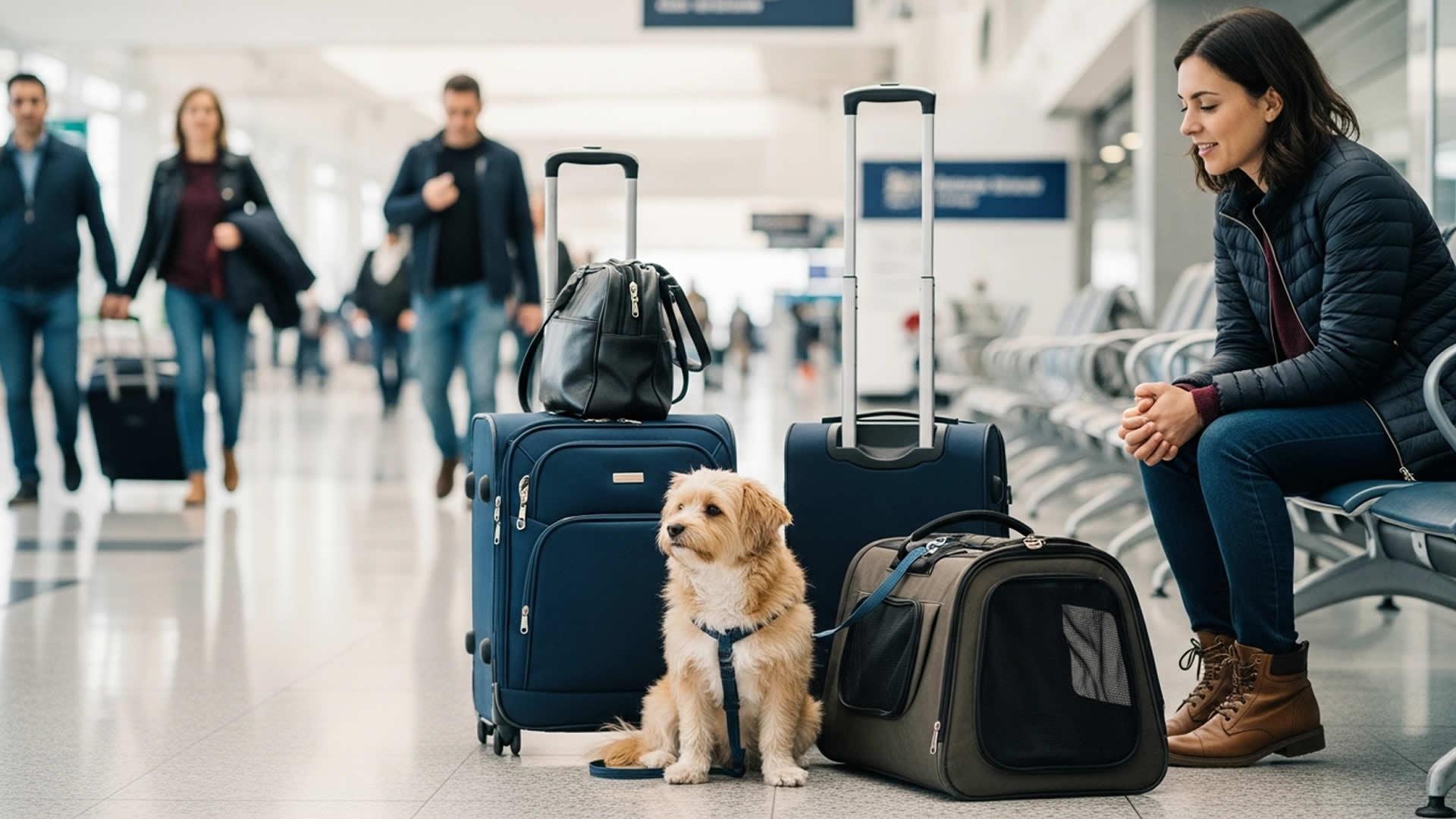
Delta Flight Diverted for Sick Dog: Was the Captain Right?
Would You Accept a 2½-Hour Flight Delay to Save a Dog? The Delta Diversion That Raises a Fascinating Question
Imagine you’re halfway across the United States at cruising altitude.
You’ve settled into your seat. Your headphones are on. Perhaps you’re watching a movie, working on your laptop or simply counting down the hours until you reach Los Angeles.
Then the captain makes an announcement.
The aircraft is diverting.
Not because of bad weather.
Get the SkypropreAir Free Travel Pack
Plan smarter, choose a better seat and enjoy a more comfortable long-haul journey. Enter your details below to receive the Travel Pack.
Not because of an engine problem.
Not because a human passenger has suffered a medical emergency.
A dog onboard has become seriously ill.
For the 181 passengers trying to reach Los Angeles, that decision would ultimately add roughly two and a half hours to their journey.
Would you be frustrated?
Or would you consider it a delay worth accepting if it could save an animal’s life?
That was the unusual situation aboard Delta Air Lines Flight 694 from Detroit to Los Angeles on May 26, 2025.
But behind what initially sounds like a heartwarming animal-rescue story lies a much more interesting aviation question:
When something goes seriously wrong at 35,000 feet, how does a captain decide whether the situation is serious enough to divert an entire aircraft?
A Routine Delta Flight Suddenly Changes Course
Delta Flight 694 departed Detroit Metropolitan Wayne County Airport bound for Los Angeles International Airport.
It should have been an ordinary domestic journey.
But roughly an hour into the flight, a dog travelling in the passenger cabin became seriously ill.
Fortunately, there was someone aboard with exactly the expertise the situation required.
A passenger with veterinary experience stepped forward to help.
The animal was assessed, and the situation was considered serious enough that continuing all the way to Los Angeles was no longer the preferred option.
The flight crew made the decision to divert to Minneapolis–St. Paul International Airport.
When the aircraft landed, assistance was available for the dog and its owner.
The remaining passengers subsequently continued their journey to Los Angeles.
But the unscheduled stop came at a price.
The diversion reportedly added approximately two and a half hours to the journey.
For 181 passengers and six crew members, one animal’s medical emergency had changed the course of an entire flight.
Unexpected disruptions are only one part of the long-haul experience — preparation, aircraft choice and seating can also make a major difference. Long-haul flight comfort guide
Who Actually Decides Whether an Aircraft Diverts?
This is where the story becomes much more interesting than the viral headline.
A commercial aircraft doesn’t simply turn toward another airport because someone onboard asks the pilots to land.
The decision to divert is ultimately an operational and safety decision.
The captain must assess the information available and decide what course of action is appropriate.
And that decision can involve far more than simply identifying the nearest airport.
Among the factors that may need to be considered are:
- The seriousness of the medical situation
- How quickly professional treatment is required
- The aircraft’s current location
- Suitable airports nearby
- Weather at those airports
- Runway availability and suitability
- Fuel remaining
- Air traffic conditions
- Ground support
- The consequences of continuing to the destination
In a human medical emergency, the crew may also seek assistance from medically qualified passengers or specialist ground-based medical services.
In this unusual case, the emergency involved an animal — and having someone with veterinary expertise onboard provided the crew with valuable information about its condition.
But the responsibility for the aircraft remained with the captain.
That is an important distinction.
The veterinarian could assess the dog. The captain had to assess the flight.
Diverting an Airliner Is Not a Small Decision
To passengers, a diversion can look deceptively simple.
The aircraft changes direction, lands somewhere else and eventually takes off again.
Behind the scenes, however, the consequences can spread quickly.
An unexpected diversion can mean additional fuel requirements, ground-handling arrangements and a new departure plan.
Passengers may miss connecting flights.
Crew duty-time limits can become an issue.
The aircraft may arrive late for its next scheduled service.
Airport slots can be affected.
Baggage and passenger arrangements may need to be reconsidered.
And in some circumstances, what begins as a relatively short diversion can produce hours of disruption.
That is why a captain must balance urgency against operational reality.
The question isn’t simply:
“Can we land?”
It is:
“Given everything we know right now, should we land?”
But Should Nearly 200 People Be Delayed for One Dog?
This is where the story becomes uncomfortable — and fascinating.
For a pet owner, the answer may seem obvious.
A dog isn’t a suitcase.
It is a living animal and, for many people, a beloved member of the family.
If the animal is in genuine medical danger and landing could save its life, many passengers would probably support the captain’s decision.
But imagine the situation from another passenger’s perspective.
Perhaps you have a connecting international flight in Los Angeles.
Perhaps you’re travelling to a wedding.
Perhaps you’re heading to an important business meeting.
Perhaps someone is waiting for you at a hospital.
Or perhaps you’ve simply spent hundreds of dollars buying a ticket on the reasonable expectation that the airline will get you to Los Angeles approximately when promised.
Suddenly, your plans are disrupted because somebody else’s dog has become sick.
Would you still support the diversion?
There isn’t necessarily a comfortable answer.
And that’s exactly what makes the incident so interesting.
If you’re choosing a seat for an upcoming journey, our Seat Comparison Database can help you compare aircraft layouts before booking.
Aviation Safety Isn’t a Popularity Contest
Imagine, hypothetically, that the captain could ask everyone onboard to vote.
“Should we divert to save the dog?”
What if 150 passengers voted no?
It wouldn’t necessarily matter.
Airline captains aren’t elected by the passengers, and critical operational decisions aren’t decided by majority vote.
The captain’s responsibility is to make the safest and most appropriate decision based on the information available at the time.
That can sometimes mean making a decision that inconveniences virtually everyone onboard.
Pilots routinely make decisions passengers may not immediately understand.
A takeoff may be rejected.
An aircraft may return to the gate.
A landing may be abandoned during a go-around.
A flight may divert hundreds of miles.
To passengers, these decisions can look frustrating.
To the flight crew, they may represent prudent risk management.
Sometimes the best aviation decision is the one passengers like least.
What Happens When Someone — or Something — Becomes Ill at 35,000 Feet?
Commercial aircraft are designed to handle an extraordinary range of situations, but they aren’t hospitals.
Cabin crew receive emergency training and aircraft carry medical equipment, but there are obvious limitations to what can be done thousands of metres above the ground.
When a serious medical situation develops, the crew has to determine whether the person can safely continue to the destination or needs professional treatment sooner.
The same basic problem arises when an animal becomes seriously ill.
There is an additional complication, however.
Human medical resources onboard aren’t necessarily appropriate for animals.
A doctor may be extremely capable of treating a passenger but may have limited knowledge of veterinary medicine.
That is why the presence of someone with veterinary experience on Delta Flight 694 was particularly fortunate.
At precisely the moment the crew needed specialist information, someone onboard could provide it.
Sometimes the Most Valuable Person on an Aircraft Is Sitting in Economy
There’s another remarkable element to this story.
Somewhere among those passengers was someone with veterinary knowledge who had presumably boarded the aircraft expecting nothing more dramatic than an ordinary journey to Los Angeles.
Then an emergency occurred.
And that passenger stepped forward.
Aviation produces moments like this surprisingly often.
Doctors respond when cabin crew ask whether there is a medical professional onboard.
Nurses assist sick passengers.
Off-duty airline employees sometimes provide assistance.
People with specialist knowledge suddenly find themselves in situations where their experience becomes enormously valuable.
On Delta Flight 694, it happened to involve veterinary expertise.
It is a reminder that sometimes the most useful emergency resource aboard an aircraft isn’t stored behind a panel or inside a medical kit.
Sometimes it’s sitting quietly in seat 22A.
Flying With a Pet Is a Serious Responsibility
The incident also raises an important issue for anyone considering flying with an animal.
Air travel can be stressful even for humans who understand exactly what is happening.
For an animal, the experience may involve unfamiliar surroundings, strange noises, long periods inside a carrier and disruption to normal routines.
Pet owners should therefore carefully consider whether their animal is healthy and comfortable enough to fly.
Airline requirements also vary significantly.
Depending on the airline, route, destination and size of the animal, pets may be permitted in the cabin, transported under specific conditions or prohibited altogether.
There can also be restrictions relating to the animal’s age, carrier dimensions and destination-country requirements.
Anyone planning to fly with a pet should therefore check the airline’s current rules well before departure rather than relying on previous travel experience.
Policies can change.
Could the Airline Simply Continue to Los Angeles?
This is perhaps the biggest misconception surrounding diversions.
Looking at a map after the event makes everything seem obvious.
People can say:
“They were already heading to Los Angeles. Why not just continue?”
But pilots don’t have the luxury of knowing how an emergency will develop.
They must make decisions based on what they know at that moment.
If the crew believes an animal’s condition could deteriorate significantly during several more hours of flight, continuing may carry a risk that cannot easily be reversed.
An aircraft can’t simply pull over five minutes later if the situation suddenly becomes critical.
That is one reason aviation decision-making tends to favour managing risk before options disappear.
Once the aircraft passes a suitable airport, that option may no longer be readily available.
What About Compensation for the Other Passengers?
Passengers naturally think about compensation when a flight is significantly disrupted.
But eligibility isn’t determined simply by the length of the delay.
It can depend on the jurisdiction, the reason for the disruption, the route and the airline’s own policies.
A diversion caused by an unexpected medical emergency is very different from a delay caused by a routine operational problem that the airline could reasonably have prevented.
Passengers affected by any significant disruption should therefore check the airline’s current policy and the passenger-rights rules applying to their particular journey rather than assuming compensation is automatically payable.
The Bigger Question: What Is a Life Worth at 35,000 Feet?
Strip away the airline name, airport codes and operational details and this story ultimately becomes a moral question.
Nearly 200 people were inconvenienced because one animal needed help.
From a purely mathematical perspective, that sounds disproportionate.
But aviation cannot always operate according to arithmetic.
We don’t normally calculate compassion by dividing inconvenience among the number of people affected.
If a human passenger suffered a life-threatening medical emergency, few people would seriously argue that the aircraft should continue simply because 180 other passengers wanted to arrive on time.
The fact that this emergency involved an animal makes the question more complicated.
And perhaps that’s why the story continues to resonate long after the flight itself.
Two and a Half Hours Late — But Perhaps for the Right Reason
Delta Flight 694 eventually continued to Los Angeles.
The passengers reached their destination approximately two and a half hours later than originally expected.
For anyone who travels regularly, a delay of that length is substantial.
For travellers concerned about comfort on longer journeys, aircraft type can also have a surprisingly large effect on the experience.
Connections can disappear.
Plans can unravel.
Tempers can rise.
Yet this particular delay wasn’t caused by congestion, a late inbound aircraft or a routine scheduling problem.
It happened because somewhere in the cabin was an animal in distress — and the information available to the crew persuaded the captain that landing sooner was the appropriate decision.
Perhaps that is one of the lessons aviation repeatedly teaches us.
Getting to our destination matters.
But occasionally, something happens at 35,000 feet that matters more.
What would you have wanted the captain to do?
If you had been one of the 181 passengers aboard and knew the diversion would delay you by two and a half hours, would you have supported the decision?
Would you accept the delay to give a seriously ill dog a better chance of survival — or do you think an airline has a greater responsibility to the hundreds of passengers whose journeys will be disrupted?
Tell us what you think.
Frequently Asked Questions
Can an airline divert because a pet becomes sick?
Yes. A flight can be diverted when the captain determines that circumstances onboard justify landing at another suitable airport. The precise decision depends on the seriousness of the situation and operational factors at the time.
Who decides whether a commercial aircraft diverts?
The aircraft’s captain ultimately has responsibility for the safe operation of the flight. Information from cabin crew, medical professionals, airline operations and other sources can help inform the decision.
Can dogs travel in an aircraft cabin?
Some airlines permit qualifying dogs and other small pets to travel in the cabin, subject to restrictions. Rules vary according to airline, route, destination, animal and carrier size, so passengers should always check the airline’s latest requirements before travelling.