
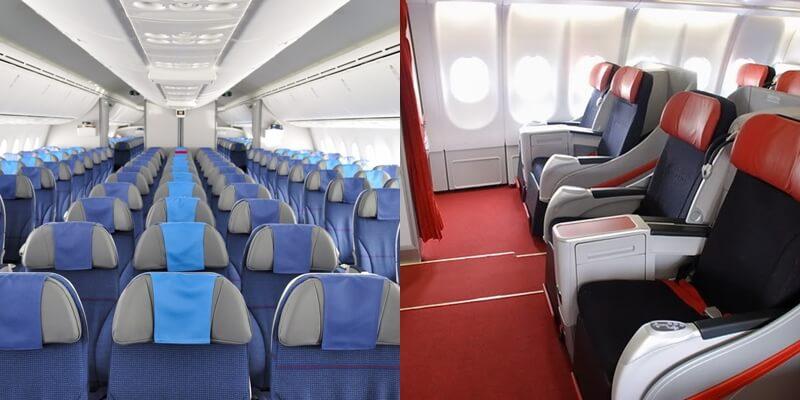
Airlines Are Adding More Premium Seats—but What Happens to Economy Passengers?
Airlines adding more premium seats are changing the shape of modern aircraft cabins and the most valuable space on board is increasingly being reserved for passengers willing to pay more.
American Airlines recently unveiled a reconfigured Boeing 777-300ER with 144 premium seats, up from 116 in the previous layout. The aircraft will feature 70 Flagship Suite business-class seats, 44 premium-economy seats and 30 Main Cabin Extra seats. Its traditional international first-class cabin is disappearing, while the number of standard economy seats is being reduced.
For passengers who can afford to upgrade, this sounds like progress: more lie-flat beds, additional privacy, improved entertainment and a greater chance of securing a premium seat.
But the majority of passengers still travel in economy. For a broader comparison of comfort across different carriers, read our guide to the [best airlines for long-haul economy].
As airlines devote more cabin space to premium products, an important question deserves attention: what happens to the passengers at the back of the aircraft?
Get the SkypropreAir Free Travel Pack
Plan smarter, choose a better seat and enjoy a more comfortable long-haul journey. Enter your details below to receive the Travel Pack.
The issue is not simply whether economy passengers receive champagne, priority boarding or access to an airport lounge. It is whether affordable seats will become more difficult to find and whether airlines will continue investing in the basic comfort of the passengers who still occupy most of the aircraft.
The Premium-Cabin Race Is Accelerating
Premium travel has become one of the airline industry’s most attractive sources of revenue.
A business-class seat occupies considerably more space than an economy seat, but it can sell for several times the price. Premium economy also gives airlines a profitable middle ground between increasingly expensive business class and increasingly restricted standard economy.
American Airlines is not alone. Airlines around the world are adding business-class suites, premium-economy cabins and extra-legroom sections. Some carriers are also removing international first class and using that space for a larger business-class cabin that can be sold to more passengers.
The commercial reasoning is understandable. Airlines face high fuel, staffing, maintenance and aircraft-acquisition costs. Premium travellers provide valuable revenue, while loyalty programmes and corporate travel strengthen demand for the most expensive seats.
However, an aircraft cabin is a fixed space. When one section expands, another section must often become smaller or be rearranged.
That is where the consequences for economy passengers begin.
Fewer Economy Seats Could Affect Availability
Reducing the number of standard economy seats does not automatically mean that every economy fare will increase. Ticket prices are influenced by demand, competition, season, route and how early the passenger books.
Nevertheless, when fewer standard seats are available on a particular aircraft, the cheapest fare categories may sell out more quickly. Passengers booking later could be left choosing between a higher economy fare, an extra-legroom seat or a premium-economy upgrade.
The flight may still technically offer economy fares, but the genuinely affordable options could become harder to secure.
This matters especially to families, students, migrant workers and leisure travellers purchasing several tickets. A modest increase per passenger can become a substantial additional cost when multiplied across an entire family.
Airlines should therefore be transparent about what is changing. Advertising a modernised aircraft without clearly explaining the revised cabin layout leaves passengers unable to judge whether the upgrade genuinely benefits them.
Economy Must Not Become an Afterthought
Premium cabins naturally attract attention. Private doors, lie-flat beds and restaurant-style meals produce impressive photographs and help airlines distinguish themselves from competitors.
Standard economy improvements are less dramatic but they affect far more people.
Our [Long-Haul Comfort Master Guide] explains how the aircraft, airline, seat and flight schedule can influence a passenger’s overall comfort.
For an economy passenger spending eight, ten or fourteen hours on an aircraft, relatively small details can determine the quality of the journey:
- sufficient legroom;
- a supportive seat;
- reasonable seat width;
- a functioning entertainment screen;
- accessible charging facilities;
- acceptable meal service;
- clean toilets; and
- cabin crew who have enough time to respond to passengers.
A new business-class suite may improve an airline’s image, but it does not compensate for an economy cabin in which passengers feel compressed, overlooked or treated merely as additional capacity.
Airlines can pursue premium revenue without neglecting basic economy comfort. These objectives do not have to be opposites.
Are Extra-Legroom Seats an Improvement or Another Charge?
The expansion of extra-legroom economy creates a more complicated picture.
For taller passengers or anyone who struggles with limited personal space, products such as Main Cabin Extra can provide a meaningful improvement without the cost of premium economy or business class.
Before paying an additional fee, consult our [Best Seats on a Plane guide] to understand which seat locations may provide better comfort and which ones could have hidden disadvantages.
More extra-legroom seats could therefore give passengers greater choice.
However, the benefit depends on how the standard cabin is treated.
If airlines maintain reasonable comfort in regular economy while offering extra space as an optional upgrade, passengers gain a useful alternative. But if standard economy becomes increasingly restrictive, extra-legroom seating begins to look less like a genuine upgrade and more like a charge for restoring comfort that passengers once expected as normal.
The crucial question is not simply how many premium or extra-legroom seats an airline installs. It is whether the remaining standard seats still provide an acceptable experience for the duration of the flight.
A Smaller Economy Cabin Could Have Some Advantages
The shift is not entirely negative for economy passengers.
If an airline reduces standard economy seats without increasing the total number of passengers dramatically, the economy cabin may feel less crowded. There could be fewer passengers competing for overhead-bin space, toilets and cabin-crew attention.
A larger premium-economy or extra-legroom section also gives passengers more upgrade choices. Someone who cannot justify the price of business class may still be able to purchase additional space and improved service.
New cabin refurbishments may also bring benefits throughout the aircraft, including newer entertainment systems, faster Wi-Fi, better lighting and additional charging facilities.
American Airlines, for example, has announced plans to install seatback entertainment screens throughout its mainline fleet. That investment benefits passengers in every cabin, not only those seated at the front.
The real concern is therefore not the existence of more premium seats. It is whether airlines use cabin modernisation to improve the overall passenger experience or concentrate nearly all meaningful improvements on higher-paying travellers.
What Passengers Should Check Before Booking
Passengers should no longer assume that two aircraft carrying the same model name will offer the same experience.
A Boeing 777-300ER operated by one airline may have a completely different seating layout from another carrier’s version. Even aircraft belonging to the same airline can have old and newly refurbished configurations operating simultaneously.
Before booking a long-haul flight, passengers should check:
1. The aircraft configuration
Look beyond the aircraft type and examine the airline’s seat map.
Use our [Best Seats on a Plane guide] to understand how factors such as row position, bulkheads, exit rows, toilets and galleys can affect your journey.
Confirm how many seats are placed across each economy row and whether premium cabins have reduced the size of standard economy.
2. Seat pitch and width
Extra-legroom branding does not always tell the full story. Compare the published seat pitch and width, while remembering that measurements may vary slightly by row and aircraft configuration.
3. What the fare includes
A cheaper ticket may exclude checked baggage, seat selection or changes. Compare the complete journey cost rather than the headline fare alone.
4. Whether the aircraft has been refurbished
Airlines may introduce upgraded cabins gradually. Check whether your particular flight is scheduled to use the new configuration, but remember that aircraft substitutions can occur.
5. The price difference between cabins
Premium economy may sometimes offer reasonable value, particularly on overnight flights.
Not every upgrade represents good value. Before paying more, read our detailed guide explaining [when premium economy is worth it] and when an extra-legroom economy seat may be sufficient.
Use our detailed guide, [Is Premium Economy Worth Paying For?], to compare the extra space, service and price before upgrading.
At other times, an extra-legroom economy seat may provide the most important benefit at a substantially lower price.
Passengers should compare the actual products and prices available on their flight instead of assuming that the cabin name guarantees value.
What Airlines Owe Their Economy Passengers
Airlines are businesses, and they have every right to develop products that passengers are willing to purchase. Expanding premium cabins can provide the revenue required to invest in aircraft, technology and service.
But commercial logic should not erase passenger responsibility.
Economy passengers may pay less individually, yet collectively they remain central to the operation of most commercial flights. They deserve clear information, humane seating conditions and a consistent standard of service.
Airlines adding more premium seats should also commit to:
- publishing accurate seat dimensions and cabin layouts;
- clearly distinguishing standard economy from extra-legroom products;
- maintaining reasonable personal space on long flights;
- improving entertainment and charging facilities throughout the aircraft;
- ensuring sufficient access to toilets and overhead storage;
- providing appropriate support for passengers with mobility or accessibility needs; and
- communicating aircraft substitutions that materially change the booked experience.
Comfort should not become something available only to passengers who can afford a substantial upgrade.
There is an important difference between offering luxury at the front and allowing discomfort to become the default at the back.
The Future of Economy Is About More Than Seat Numbers
The growth of premium seating reveals where airlines believe the strongest profits will come from. More travellers are willing to pay for privacy, space and a better chance of resting on long journeys, and airlines are responding.
But removing standard economy seats does not remove the needs of economy passengers.
Most travellers will continue to judge an airline by fundamental experiences: whether the seat is tolerable, whether the information is clear, whether the crew treats them respectfully and whether they arrive without feeling unnecessarily exhausted.
Our [Long-Haul Flight Survival Guide] provides practical ways to reduce discomfort, rest more effectively and cope with the physical demands of an extended flight.
The airlines that succeed in the long term may not be those with the largest business-class cabins. They may be those that understand how to make premium travel more attractive without making ordinary economy passengers feel less important.
Premium expansion and economy comfort can coexist but only when airlines choose to invest in both.
Price still matters, but the lowest advertised fare is not always the best overall value. Our guide to [finding cheap long-haul flights] explains how to compare fares without overlooking baggage charges, seat-selection fees and inconvenient flight times.
Compare Long-Haul Flight Options
Compare routes, fares and airlines before booking. Check the aircraft and seat configuration separately to ensure that the cheapest option also provides acceptable comfort.
Search and compare long-haul flights with Aviasales.
Before selecting your next long-haul flight, compare the full cabin configuration rather than relying solely on the airline’s advertising. The best value may be found in standard economy, an extra-legroom seat or premium economy but only when you understand exactly what your fare provides.