
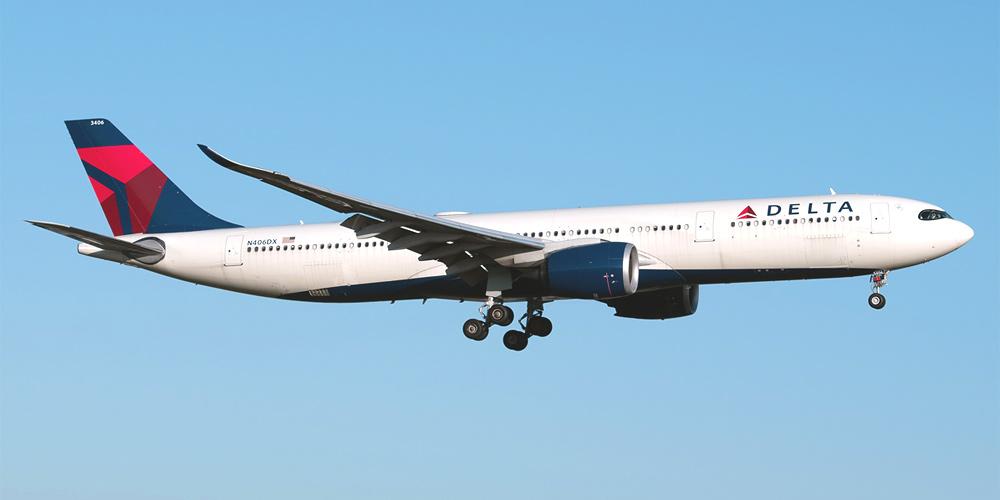
Delta Flight Diverts After Lavatory Leak: How Can a Toilet Problem Force a Plane to Land?
Delta Flight Diverts After Lavatory Leak: How Can a Toilet Problem Force a Plane to Land?
Imagine Flying to Seattle—Then Liquid Starts Spreading Across the Cabin Floor
You’re settling into a long-haul flight.
Paris is disappearing behind you.
Ahead lies Seattle and more than ten hours in the air aboard a modern Airbus A330neo.
Then something goes wrong.
Not with an engine.
Get the SkypropreAir Free Travel Pack
Plan smarter, choose a better seat and enjoy a more comfortable long-haul journey. Enter your details below to receive the Travel Pack.
Not with the wings.
Not with the flight controls.
A lavatory develops a mechanical problem.
For the passengers aboard Delta Air Lines Flight DL81, that seemingly ordinary problem became serious enough for the Paris-to-Seattle flight to divert to London Heathrow.
And the disruption didn’t end there.
What should have been a nonstop transatlantic journey ultimately involved London and New York before passengers reached Seattle.
But the incident raises a fascinating question:
How can a problem with an aircraft toilet become serious enough to divert a long-haul passenger jet?
The answer reveals that something passengers barely think about can become an operational problem at 35,000 feet.
What Happened to Delta Flight DL81?
Delta Flight DL81 departed Paris Charles de Gaulle Airport for Seattle-Tacoma International Airport on August 13.
The aircraft was an Airbus A330-900neo.
According to Delta, there were 209 passengers and 13 crew members aboard.
After departure, the crew encountered what Delta described as a mechanical issue involving an onboard lavatory.
Rather than continue across the Atlantic, the pilots diverted to London Heathrow.
Passenger accounts subsequently described liquid spreading onto parts of the cabin floor and blankets being placed over affected sections.
However, this distinction matters:
It has not been officially established that the liquid was sewage.
A lavatory-related leak could potentially involve different parts of the aircraft’s water or drainage systems.
Why Would a Lavatory Problem Require a Diversion?
An aircraft toilet may seem like a passenger-convenience system.
But once a leak begins affecting the cabin, the crew has more to consider than whether passengers can use the toilet.
They may need to assess:
- where the liquid is coming from
- whether the leak can be isolated
- whether it is continuing to spread
- sanitation and passenger conditions
- whether other aircraft systems could potentially be affected
- whether enough usable lavatories remain for the flight ahead
On a short flight, the calculation might be relatively simple.
On a flight from Europe to America’s West Coast, however, the aircraft could remain airborne for many more hours.
A manageable problem early in the journey could become much harder to manage halfway across the Atlantic.
That’s why pilots don’t simply ask:
“Can the aircraft keep flying?”
They also have to consider:
“Is continuing the safest and most practical course of action?”
Aircraft cabin conditions can also affect passengers in less obvious ways. Our guide to how cabin air, pressure and humidity affect your body on long flights explains what happens to the cabin environment at cruising altitude.
Then Came Another Problem: The Aircraft Was Heavy
The diversion created an additional complication.
DL81 had departed Paris carrying fuel for a long flight to Seattle.
When it turned toward Heathrow relatively early in the journey, much of that fuel was still aboard.
That meant the aircraft was heavier than it would normally be toward the end of a long-haul flight.
Delta said the crew declared an emergency approaching Heathrow because the aircraft would be making an overweight landing.
It nevertheless landed normally and safely.
Does an overweight landing mean the aircraft is about to crash?
No.
An overweight landing means an aircraft is landing above its normal maximum landing weight.
Aircraft and crews have procedures for situations where operational circumstances make such a landing necessary.
The aircraft may subsequently require inspections or maintenance checks depending on the circumstances.
The word “emergency” can understandably alarm passengers, but an emergency declaration also gives pilots and air traffic controllers additional operational priority when circumstances require it.
Why Didn’t the Pilots Simply Dump Fuel?
This is another interesting part of the incident.
Not every passenger aircraft is equipped with a fuel-jettison system.
Reporting on DL81 noted that the A330neo involved did not simply dump its transatlantic fuel before landing.
When an aircraft cannot or does not need to jettison fuel, pilots have other options depending on the situation.
They may remain airborne to burn fuel.
Or, when circumstances justify landing sooner, they can conduct an overweight landing using the appropriate procedures.
In this case, getting the aircraft on the ground to deal with the lavatory problem took priority.
The Aircraft Was Repaired—but the Journey Still Wasn’t Over
Maintenance personnel worked on the aircraft at Heathrow.
The A330neo subsequently departed again.
But the original disruption had created another operational problem:
crew duty time.
Pilots and cabin crew cannot simply continue working indefinitely because a flight has been delayed.
Aviation regulations impose limits designed to manage fatigue.
Delta said the aircraft therefore stopped at New York JFK, where passengers cleared U.S. Customs, before continuing to Seattle.
So one lavatory-related mechanical problem triggered a chain reaction:
Paris → London → New York → Seattle.
That is an excellent example of how aviation disruptions can compound.
A mechanical problem creates a diversion.
The diversion creates a delay.
The delay affects crew duty limits.
And that can create another stop.
Long delays can also completely disrupt a passenger’s sleep and body clock. See our Overnight vs Daytime Flights guide for strategies to reduce long-haul fatigue.
Could an Aircraft Continue Flying With One Lavatory Out of Service?
Potentially, yes.
A single unusable toilet doesn’t automatically mean an aircraft must land immediately.
Large long-haul aircraft normally have multiple lavatories.
But there is an important difference between:
one lavatory simply being unavailable
and
an active mechanical problem involving liquid spreading into the cabin.
The crew must assess the actual circumstances.
Flight duration matters too.
Losing one lavatory near the destination is very different from developing an uncontrolled problem shortly after departure with many hours of flying remaining.
Was the Airbus A330neo Itself Unsafe?
Nothing in the available reporting suggests that this incident demonstrates a broader safety problem with the Airbus A330neo.
This was reported as a lavatory-related mechanical issue on an individual aircraft.
That’s an important distinction.
Aircraft contain thousands of components and systems.
Mechanical defects occur.
The important question is how crews, maintenance teams and airlines respond when they do.
In this case, the pilots diverted and the aircraft landed safely.
In fact, the A330/A330neo can offer some advantages for Economy passengers, particularly on aircraft retaining a 2-4-2 layout. See our Best Aircraft for Long-Haul Economy Flights guide for the wider comparison.
What Passengers Can Learn From DL81
The story sounds extraordinary because of the system involved.
“A plane diverted because of a toilet” makes a dramatic headline.
But the more interesting lesson is how commercial aviation manages uncertainty.
Pilots don’t necessarily wait until a malfunction becomes dangerous.
They assess whether continuing the flight could allow a manageable problem to deteriorate.
That can mean inconvenience.
It can mean an unexpected airport.
It can even mean turning a ten-hour nonstop journey into a much longer trip.
But the principle remains the same:
solve the problem while you still have good options available.
The Bigger Picture
Delta apologized to customers, saying the experience was not what it strives to provide and that its focus was getting passengers to their destinations safely and as quickly as possible.
For passengers, however, DL81 demonstrates something rarely visible during normal travel.
A long-haul flight is an interconnected operation involving aircraft systems, fuel, airports, maintenance teams, air traffic control and strict crew-duty rules.
When one element fails, the consequences can ripple through the entire journey.
And sometimes the system that starts that chain isn’t an engine or sophisticated flight computer.
Sometimes it’s a lavatory.
Planning a long journey involves more than choosing the cheapest ticket. See our Long-Haul Comfort Master Guide — Complete Strategy for Comfortable Flying for aircraft, seat, timing and cabin-comfort strategies.
FAQs
Can a broken aircraft toilet force a plane to land?
Yes, depending on the nature of the malfunction. One unavailable lavatory may not require a diversion, but an active leak or another problem that cannot be safely controlled can influence a crew’s decision to land.
Is an overweight landing dangerous?
Aircraft have procedures for overweight landings when operational circumstances require them. In the DL81 incident, Delta said the aircraft landed normally and safely at Heathrow.
Was the liquid aboard Delta DL81 confirmed to be sewage?
No. Passenger reports described liquid spreading through the cabin, but Delta publicly described the problem as a mechanical issue involving a lavatory. The exact source of the liquid has not been officially confirmed.