
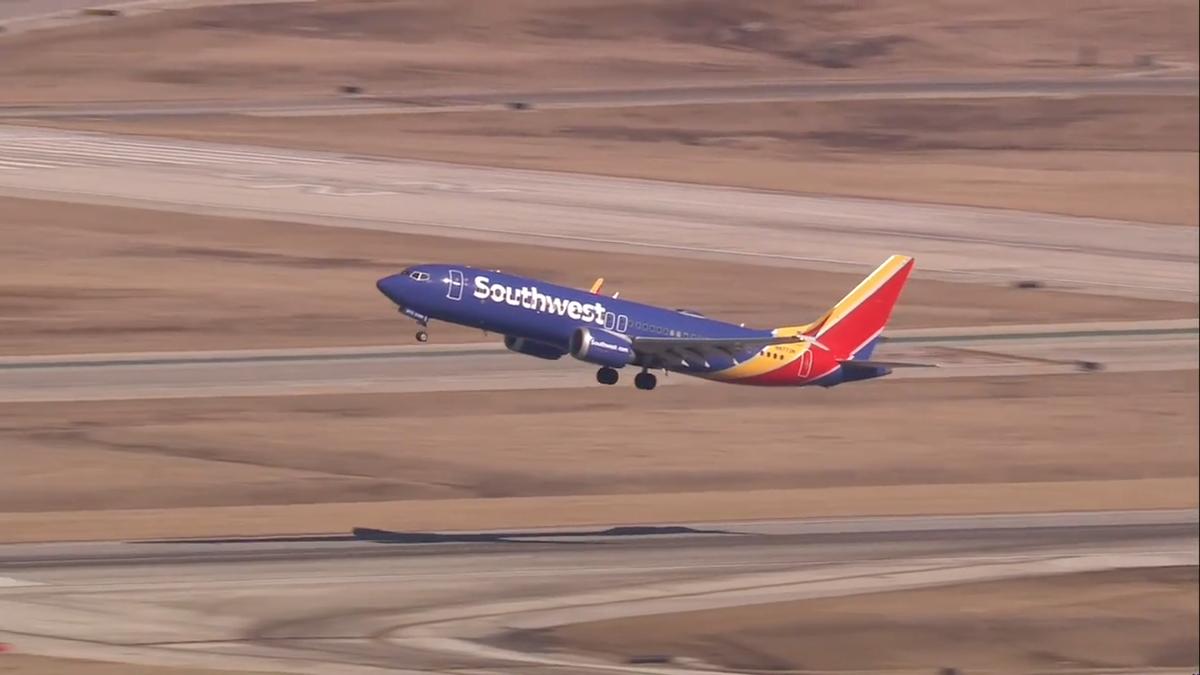
Southwest Near Miss: How a Go-Around Prevented Disaster
The Southwest near miss at Chicago Midway shows how a routine landing can become a serious runway emergency within seconds.
A Boeing 737 was seconds from landing when a private jet moved onto the runway ahead of it.
The Southwest Airlines pilots immediately abandoned the landing, applied power and climbed steeply over the other aircraft.
At their closest point, the two planes were separated vertically by approximately 175 feet.
The dramatic footage is circulating widely again on social media, where viewers are praising the Southwest pilots and questioning how two aircraft came so close to a potentially catastrophic collision.
Get the SkypropreAir Free Travel Pack
Plan smarter, choose a better seat and enjoy a more comfortable long-haul journey. Enter your details below to receive the Travel Pack.
But there is one important fact missing from many viral posts:
The incident did not happen today.
It occurred at Chicago Midway International Airport on February 25, 2025. Its renewed popularity offers an opportunity to understand what actually happened and why the pilots’ decision to perform a go-around demonstrates aviation safety working exactly as intended.
What Happened During the Southwest Near Miss?
Southwest Airlines Flight 2504, a Boeing 737-800 carrying 136 passengers and six crew members, was arriving from Omaha and had been cleared to land on Runway 31C at Chicago Midway.
At the same time, Flexjet Flight 560, a Bombardier Challenger 350 carrying two pilots and one passenger, was taxiing for departure.
The Flexjet crew had been instructed to travel along Taxiway F, turn onto Runway 04L, cross Runway 31L and hold short of Runway 31C.
“Hold short” is an explicit instruction requiring an aircraft to stop before entering or crossing a particular runway.
According to the National Transportation Safety Board’s preliminary findings, the Flexjet crew initially read back the taxi instructions incorrectly. The ground controller repeated the instructions and received a correct readback.
However, the private jet subsequently continued towards Runway 31C.
The controller transmitted another instruction telling the crew to hold short, but that message was not acknowledged.
By then, the Southwest 737 was on final approach.
The Moment the Southwest Pilots Saw the Danger
As the Southwest aircraft descended towards Runway 31C, both pilots saw the Challenger moving perpendicular to their landing path.
The Southwest first officer realised the private jet was not stopping and called for a go-around. The captain immediately executed the manoeuvre.
The Boeing 737 descended to approximately 25 feet above the runway before climbing again. When it passed over the Challenger farther along the runway, the aircraft were separated vertically by approximately 175 feet.
The Southwest pilots later returned for another approach and landed safely. Nobody aboard either aircraft was injured.
The Flexjet aircraft departed approximately 25 minutes later and completed its journey to Tennessee.
The incident was serious, but it did not become an accident because the Southwest crew recognised that the runway was no longer safe and acted without hesitation.
What Is a Go-Around?
A go-around is the deliberate decision to discontinue an approach or landing and climb away from the runway.
The pilots increase engine power, establish a safe climbing attitude, retract the landing gear and flaps in the correct sequence and follow either a published missed-approach procedure or instructions from air traffic control.
Once the aircraft is safely established in the climb, the crew can prepare for another landing attempt or divert elsewhere.
Passengers sometimes interpret a sudden increase in engine noise and a steep climb near the runway as evidence that something has gone dangerously wrong.
In reality, a go-around is a standard and carefully practised safety manoeuvre.
Pilots may perform one because of:
- Another aircraft or vehicle on the runway
- Unstable speed, altitude or descent rate
- Strong or shifting winds
- Poor visibility
- Inadequate separation from the aircraft ahead
- A late landing clearance
- An approach that is not properly aligned
- Animals or debris on the runway
- A technical warning
- Any concern that makes the crew uncomfortable about continuing
Pilots do not need to prove that a collision or accident will occur before initiating a go-around.
If a safe landing is no longer assured, climbing away is the correct decision.
Why the Southwest Pilots Had So Little Time
Landing is one of the most demanding phases of flight.
As an aircraft approaches the runway, the pilots are monitoring its speed, altitude, descent path, wind, configuration and surroundings. They must also remain prepared to abandon the landing until the aircraft is safely on the ground.
In this case, the Southwest crew was dealing with a rapidly developing obstruction.
The private jet was not sitting stationary on the runway from a great distance. It was moving towards and across the landing path while the Boeing 737 was descending.
That gave the pilots only seconds to recognise that it was not stopping and respond.
The first officer’s situational awareness and the captain’s immediate execution of the go-around prevented the situation from becoming far worse.
The manoeuvre was described in the preliminary report as smooth and without incident.
Did Sun Glare Cause the Runway Incursion?
The Flexjet pilots told investigators that sunlight impeded visibility from the right side of the cockpit.
They also reported confusion about their position on the airport surface.
According to the preliminary findings, the crew believed that they had not yet crossed Runway 31L and did not recall seeing the hold-short markings for Runway 31C. They looked in both directions before continuing but did not see the Southwest aircraft approaching.
Sun glare may therefore have contributed to the crew’s difficulty identifying markings and understanding their location.
However, it is important not to turn a preliminary investigation into a final verdict.
Some social-media posts claim that the FAA and NTSB definitively “placed blame” on the Flexjet crew. That wording goes beyond what a preliminary report establishes.
A preliminary report records early factual information gathered by investigators. It does not necessarily determine the complete probable cause, assign legal liability or close the investigation.
The confirmed sequence—including the taxi confusion, unacknowledged hold-short transmission and reported glare—is serious enough without exaggeration.
What Is a Runway Incursion?
A runway incursion occurs when an aircraft, vehicle or person is incorrectly present within the protected area designated for aircraft landing or taking off.
Not every incursion produces an immediate collision risk. Some occur when no other aircraft is close to the runway.
Others, like the Midway incident, can become extremely dangerous because an arriving or departing aircraft is already using the same space.
Runway safety depends on several layers working together:
- Clear air traffic control instructions
- Accurate readbacks from pilots
- Signs and painted surface markings
- Runway lighting
- Airport diagrams
- Situational awareness in the cockpit
- Monitoring by controllers
- Surveillance and warning technology
- The willingness to stop or go around whenever uncertainty develops
When one layer fails, the remaining protections become critical.
At Midway, the Southwest pilots provided the final protective layer.
Why Didn’t Air Traffic Control Stop the Flexjet Earlier?
The controller did instruct the Flexjet to hold short as it approached Runway 31C, but the transmission was not acknowledged.
From the cockpit, pilots must listen to radio instructions while simultaneously navigating an unfamiliar and sometimes complicated airport surface.
From the control tower, controllers must monitor multiple aircraft operating on different frequencies and sections of the airport.
The Southwest flight was communicating with the tower controller responsible for landing traffic. The Flexjet was communicating with ground control while taxiing.
This division of responsibilities is normal, but it illustrates why precise communication and coordination matter.
A correct readback does not complete the safety process. The crew must also correctly identify its location and carry out the clearance exactly as issued.
Why Midway Can Be Challenging
Chicago Midway is a busy airport with intersecting runways and a relatively compact layout.
The arrangement can require aircraft to taxi along or cross runways before reaching another runway. Pilots must distinguish between taxiways, active runways and specific hold-short points while maintaining communication with controllers.
Clear airport diagrams, signs and markings support that process, but pilots must still maintain continuous awareness—particularly when glare, darkness, snow or unfamiliar surroundings make visual identification more difficult.
If the crew becomes uncertain about its position, the correct response is to stop and ask air traffic control for clarification.
There is no penalty for choosing certainty over speed.
Related Reading: Why Some Flights Feel More Turbulent Than Others
Are Go-Arounds Dangerous?
A go-around requires concentration, correct aircraft handling and coordination between the pilots, but it is not an improvised emergency stunt.
Commercial pilots practise the procedure repeatedly in flight simulators. Airlines establish standard callouts and task divisions so each crew member knows what to do.
The greatest danger often comes from continuing an approach that has become unstable or unsafe—not from abandoning it.
Passengers should therefore view a go-around as reassuring evidence that the pilots are willing to place safety ahead of schedules, fuel use or convenience.
A landing is never compulsory.
What Passengers May Experience During a Go-Around
A go-around can feel dramatic inside the cabin.
Passengers may notice:
- A sudden increase in engine power
- A steeper-than-expected climb
- Changes in aircraft pitch
- Landing gear retracting
- Flaps being repositioned
- A delay before the pilots explain what happened
- Another circuit around the airport
The flight deck is busiest during the first stages of the manoeuvre. Pilots must fly the aircraft, communicate with air traffic control and complete the required procedures before addressing passengers.
A delayed announcement does not mean the crew has lost control. It usually means flying the aircraft is taking priority over explaining the situation.
Did the Southwest Pilots “Save Hundreds of Lives”?
The pilots unquestionably prevented a dangerous runway conflict from progressing.
However, aviation reporting should avoid pretending to know with certainty what would have happened if they had continued.
The aircraft were moving, their precise trajectories were changing, and investigators analyse far more information than a viral video reveals.
What can be said confidently is this:
The runway was obstructed, the landing was no longer safe, and the Southwest crew initiated the correct manoeuvre at a critically important moment.
Their professionalism deserves recognition without turning technical uncertainty into sensational certainty.
Why the Video Is Trending Again
The Southwest near miss continues to attract attention because the footage demonstrates how quickly a runway incursion can develop.
Aviation videos frequently return to social-media feeds months or years after the original event.
New accounts repost them, algorithms present them to fresh audiences, and captions sometimes omit the date—making old footage appear like breaking news.
That does not make the incident irrelevant.
The Midway near miss remains an important demonstration of situational awareness, runway-incursion risk and the purpose of a go-around.
But publishers and social-media users should identify it accurately as a February 2025 event rather than presenting it as something that happened today.
The Most Important Lesson for Passengers
Passengers often judge a flight by whether it takes off and lands on time.
Pilots judge each phase by whether it can be completed safely.
If the runway becomes obstructed, the approach is unstable or any important condition is uncertain, the safest landing may be the one the pilots refuse to attempt.
The Southwest crew did not “miss” the landing at Chicago Midway.
They rejected an unsafe landing, climbed away and returned when the runway was clear.
That distinction matters.
Final Thoughts
The renewed attention surrounding the Chicago Midway video should not be reduced to anger, blame or demands that licences be revoked before the investigation is complete.
It should remind us that aviation safety depends on human beings recognising developing threats and acting decisively.
Confusion occurred on the ground. A private jet entered the active runway. A Boeing 737 was only seconds from touching down.
Then the final layer of protection worked.
The Southwest pilots saw the danger, initiated a go-around and returned to land safely.
For passengers, the lesson is simple:
A go-around is not a failed landing. It is a successful safety decision.
Would you feel frightened if your aircraft suddenly climbed away from the runway or reassured that the pilots refused to continue an unsafe approach?
FAQs
What is a go-around in aviation?
A go-around is a controlled manoeuvre in which pilots discontinue an approach or landing, apply power and climb away from the runway before preparing for another attempt or diverting.
Why did the Southwest plane go around at Chicago Midway?
The pilots saw a Flexjet Challenger entering the runway on which they had been cleared to land. They abandoned the approach to avoid the runway conflict.
How close did the aircraft come?
According to the NTSB’s preliminary information, the aircraft were separated by approximately 175 feet vertically at their closest point during the Southwest aircraft’s climb.
Should passengers worry when an aircraft performs a go-around?
No. Although it can feel dramatic, a go-around is a normal safety procedure used whenever the pilots determine that continuing the landing would be inappropriate or unsafe.